
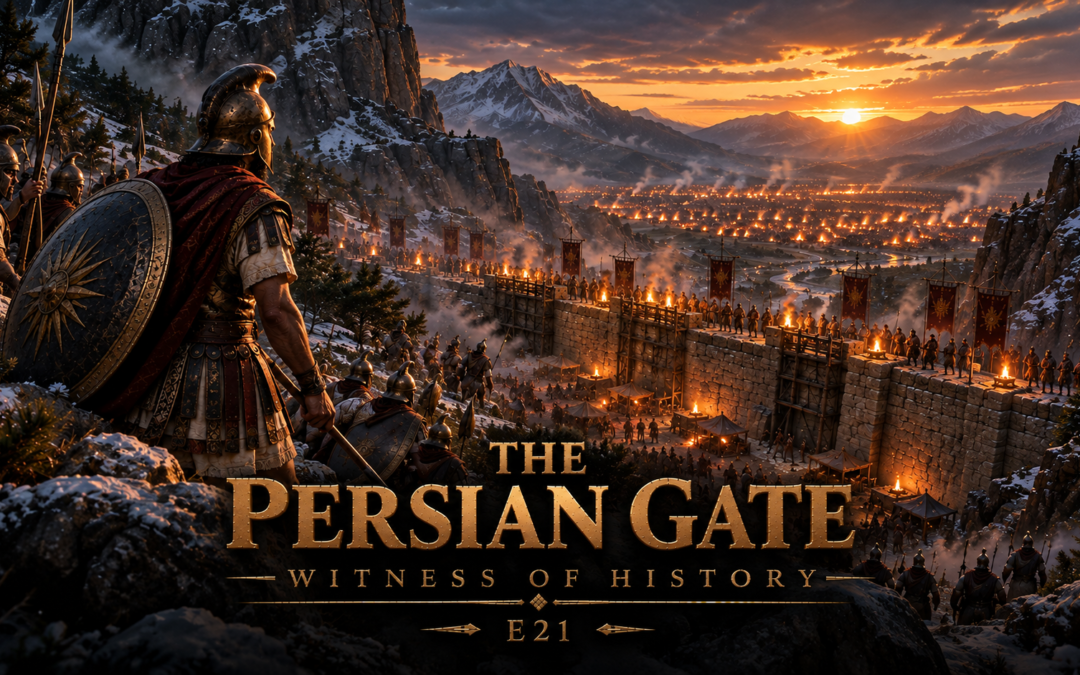
What happened when Alexander the Great was finally forced to retreat? After Babylon and Susa, In the frozen mountains of Persia, a Macedonian shield-bearer witnesses Ariobarzanes turn the narrow Persian Gate into a deadly trap, stopping Alexander's advance toward Persepolis. This immersive historical podcast follows the failed frontal assault, the dangerous mountain route around the Persian defenses, and the striking reversal of Thermopylae, nearly 150 years after Persians outflanked Greeks at a mountain pass, Greeks and Macedonians now did the same to the Persians.
Narrator: Theron, Macedonian shield-bearer in Alexander’s army
Setting: The Persian Gate, Zagros Mountains, Persis, winter 331/330 BCE
1. Sources
a. Ancient Sources
- Arrian: Anabasis of Alexander, Book 3.18 The principal account of the Persian Gate: Ariobarzanes, the defensive position, Alexander’s initial failure, the guide, the mountain maneuver, Craterus remaining at the pass, and the final encirclement.
- Quintus Curtius Rufus: History of Alexander, Book 5.3-4 An important alternative account of the battle, including the Persian defenses, Alexander’s setback, the difficult mountain route, and the coordinated attack.
- Diodorus Siculus: Library of History, Book 17 Particularly useful for the harsh conditions of the flanking march, including the snow, difficult terrain, ravines, and mountain landscape.
- Polyaenus: Stratagems, Book 4 Preserves traditions concerning Alexander’s tactics and deception during the operation.
- Herodotus: Histories, Book 7 Used for the Thermopylae parallel: Xerxes’ inability to break the Greek position frontally, the revelation of the mountain path, and the Persian movement around the defenders. This is essential because the closing of the episode deliberately reverses the famous Thermopylae situation.
b. Modern Sources
- Adrian Goldsworthy - Philip and Alexander: Kings and Conquerors Used for Alexander’s campaign narrative and the military context of the advance from Susa toward Persepolis.
- Philip Freeman - Alexander the Great Used extensively for the Persian Gate narrative: Ariobarzanes’ position, the wall, missile attack, Alexander’s retreat, the mountain maneuver, winter conditions, and the eventual destruction of the Persian defense. Freeman also stresses the strategic urgency of reaching Persepolis.
- Peter Green - Alexander of Macedon, 356–323 B.C.: A Historical Biography Used as part of the wider reconstruction of Alexander’s movement from Susa through Persis and toward Persepolis.
2. Author’s Notes
a. Historical
- The Battle of the Persian Gate took place during Alexander’s advance from Susa toward Persepolis in the winter of 331/330 BCE. Ariobarzanes, satrap of Persis, defended the narrow mountain approach into the Persian heartland.
- Alexander divided his forces, sending Parmenion by the easier southern route while he took a smaller force through the mountains toward the Persian Gate.
- Ariobarzanes had prepared a strong defensive position, including a wall across the pass. The Macedonians were struck from above with stones and missiles, and Alexander’s first frontal assault failed badly enough that he ordered a retreat.
- Alexander subsequently learned of a route around the position and left Craterus behind with part of the army while taking selected troops through the mountains to outflank the Persians. Craterus was instructed to attack when Alexander gave the signal.
- Alexander eventually reached the rear of the Persian position. The resulting attacks from different directions broke Ariobarzanes’ defense and opened the road to Persepolis.
- Ancient estimates for the size of Ariobarzanes’ army are unreliable and probably exaggerated, which is why the episode avoids giving a precise number.
- The comparison with Thermopylae is a historical parallel rather than evidence that Alexander deliberately intended to reenact the earlier battle: a Persian force now defended a narrow pass, while Alexander’s army ultimately succeeded by using a mountain route to reach its rear.
b. Reconstructed
- Theron is fictional, as are his personal experiences, thoughts, and conversations during the battle.
- Details such as the soldiers’ experience of the retreat, the silence of the night march, Theron watching the Persian position, and his reflections on Thermopylae are dramatic reconstructions built around the known course of the campaign.
- The precise sequence and details of the outflanking operation differ between the surviving ancient accounts. The episode presents a coherent reconstruction rather than treating every reported detail as certain.
- The episode’s central idea, that Alexander experienced the unusual humiliation of being stopped and forced back before finding another way through, reflects the historical outcome of the failed frontal assault, while Theron’s emotional interpretation is fictional.