
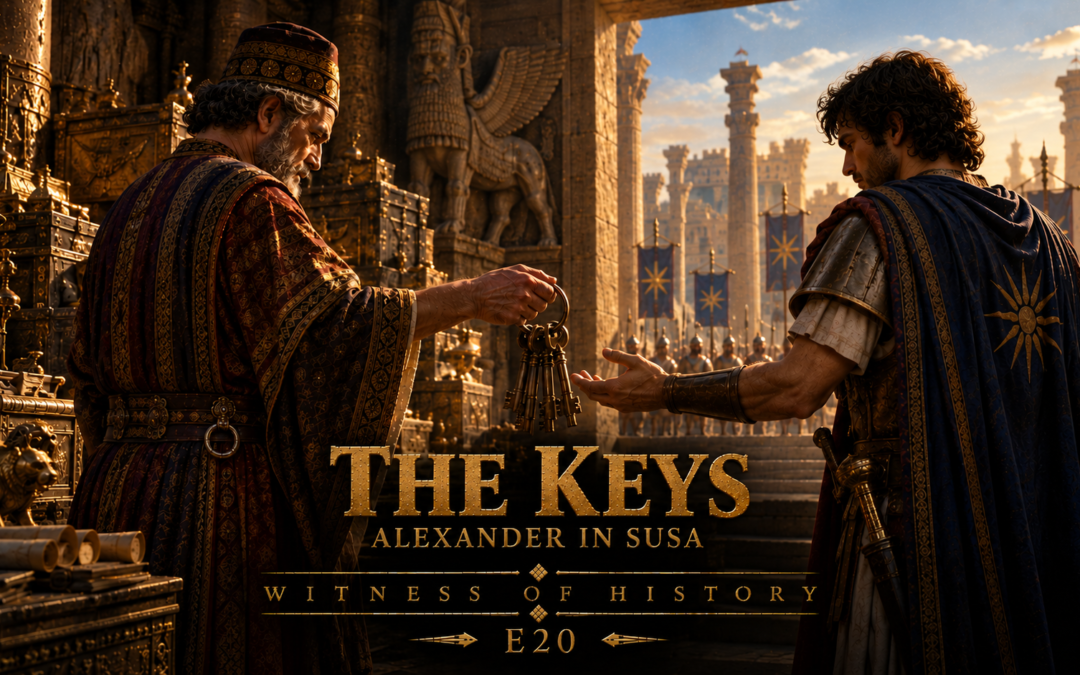
What happens to an empire when its king is still alive, but his treasury has already changed hands? Through the eyes of a Persian treasury official, witness Alexander's arrival in Susa and the surrender of one of the Achaemenid Empire's great royal treasuries. This immersive historical podcast explores Persian wealth, royal administration, loyalty, and the unsettling realization that an empire may survive even as the king who once embodied it loses control.
Narrator: Persian Treasury Official
Setting: Susa, 331 BCE
1. Historical Sources
Ancient Sources
- Arrian, Anabasis of Alexander, Book III, Chapter 16 - Alexander’s arrival at Susa, its surrender, the seizure of the royal treasury, the enormous quantity of treasure found there, and Alexander’s administrative arrangements after taking the city.
- Diodorus Siculus, Library of History, Book XVII, Chapters 65–66 - the surrender of Susa and the contents of its treasury, including more than 40,000 talents of uncoined gold and silver and another 9,000 talents in gold darics.
- Quintus Curtius Rufus, Histories of Alexander the Great, Book V, Chapter 2 - Alexander’s peaceful entry into Susa, the surrender by Abulites, the royal treasury, and the administrative settlement that followed.
- Plutarch, Life of Alexander, Chapter 36 - the immense wealth Alexander acquired at Susa and the scale of the Achaemenid royal treasure.
- Justin, Epitome of Pompeius Trogus, Book XI, Chapter 14 - Alexander’s occupation of Susa and the wealth acquired there.
Modern Sources
- Adrian Goldsworthy, Philip and Alexander: Kings and Conquerors - Alexander’s campaign after Gaugamela and his progressive assumption of control over the Achaemenid Empire.
- A. B. Bosworth, Conquest and Empire: The Reign of Alexander the Great - Alexander’s treatment of conquered Persian territories and his developing system of imperial administration.
- Peter Green, Alexander of Macedon, 356–323 B.C. - the political significance of Alexander’s capture of Babylon, Susa, and the other Achaemenid royal centers.
2. Author’s Notes
Historical
- Susa was one of the great royal and administrative centers of the Achaemenid Empire. It contained royal palaces and an enormous treasury accumulated by generations of Persian kings. Modern scholarship describes it as perhaps the most important Achaemenid capital from an administrative perspective.
- Alexander approached Susa after his decisive victory over Darius III at Gaugamela in 331 BCE and his subsequent occupation of Babylon.
- Susa was surrendered without a major battle. The satrap of Susiana, Abulites, communicated his willingness to surrender to Alexander through Philoxenus and subsequently sent his son to meet Alexander.
- The ancient sources disagree slightly over the precise amount of treasure captured. Arrian and Curtius give approximately 50,000 talents, while Diodorus describes more than 40,000 talents of uncoined gold and silver plus 9,000 talents of gold darics. The safest conclusion is simply that Alexander acquired an extraordinary concentration of Achaemenid royal wealth.
- This treasure was not merely a collection of coins. Diodorus specifically describes huge quantities of uncoined precious metal, while other royal property and valuable objects were also stored at Susa. This supports the episode's effort to portray the treasury as something considerably more complex than rooms filled with coins.
- Among the objects discovered were items the Persians had carried away from Greece during the Persian Wars, including the bronze statues of the Athenian tyrannicides Harmodius and Aristogeiton. Alexander ordered these returned to Athens.
- Alexander did not dismantle the existing Persian administration completely. Abulites remained satrap of Susiana, while Alexander installed Macedonian personnel in strategically important positions. Arrian names Mazarus as commander of the citadel garrison and Archelaus as military commander; other traditions also preserve arrangements for supervision of the treasury.
- This mixture of continuity and Macedonian control is important to the episode. Alexander was conquering the Achaemenid Empire while simultaneously beginning to use parts of the administrative system he had inherited.
- Darius was still alive when Susa surrendered. He had escaped from Gaugamela and was attempting to gather another force farther east. His death would not come until 330 BCE.
- This creates the historical situation at the center of the episode: the Achaemenid king was still alive, but one of the principal capitals of his empire, its administration, and an enormous portion of its accumulated royal wealth had already passed into Alexander’s hands.
- Alexander's acquisition of the treasuries at Babylon, Susa, Persepolis and Pasargadae fundamentally changed the financial position of his campaign. The expedition that had begun with comparatively limited Macedonian resources now possessed access to the accumulated wealth of the empire it was conquering.
- Susa itself did not disappear with the fall of the Achaemenid dynasty. It remained an important imperial center under Alexander and later Hellenistic rulers. Alexander would return there in 324 BCE, when the city became the setting for the famous Susa weddings.
Reconstructed
- The narrator is fictional. We do not possess the personal testimony of a Persian treasury official who surrendered Susa’s treasury to Alexander.
- His thirty years of service, his father and grandfather having held the same responsibility, and the inheritance of the keys are fictional.
- The physical keys themselves are a storytelling device. The ancient sources describe Alexander taking possession of Susa and its treasury, but they do not record a ceremonial transfer of treasury keys from an elderly Persian official.
- The narrator’s detailed work with vaults, seals, inventories and records is reconstructed from the highly developed administrative culture of the Achaemenid Empire rather than from evidence for this particular individual.
- The order to inspect every chamber before Alexander arrives is fictional. It represents the practical preparations that would plausibly accompany the transfer of an enormous royal treasury but is not described by our surviving sources.
- The narrator personally receiving reports of Granicus, Issus, Tyre, Egypt and Gaugamela is reconstructed. These events would obviously have been of enormous importance to the imperial administration, but we cannot know what information a particular treasury official at Susa received or when.
- The episode simplifies Alexander’s arrival by presenting the transition almost entirely through the treasury. Historically, the surrender was negotiated at a much higher political level by Abulites, the satrap of Susiana.
- The peaceful nature of the transition, however, is historical. Alexander did not have to storm Susa. Its authorities surrendered the city and its treasure.
- The narrator's belief that “the empire made sense because [Darius] sat upon the throne” is fictional and should not be taken as a reconstruction of a specifically Persian political philosophy.
- Likewise, his father’s recurring lesson “Never mistake the king for the empire.” is entirely fictional. It provides the episode's central theme rather than representing a surviving Persian saying.
- The narrator's sense of betrayal when he realizes that he feels relieved by an orderly surrender is reconstructed.
- His conclusion that he has “chosen the empire over the king” is also interpretive. We cannot know how individual Persian administrators understood their continued service when authority passed from Darius to Alexander.
- The episode deliberately avoids portraying Susa as simply “betraying” Darius. After Gaugamela, Alexander controlled Babylon and was approaching with the victorious Macedonian army, while Darius had withdrawn eastward. Abulites' decision is better understood within the rapid collapse of effective Achaemenid control in Mesopotamia and Susiana.
- Most importantly, the final image of Darius still moving east while Susa has stopped waiting for him is literary rather than literal. But it captures a real historical transformation: Darius III remained the Achaemenid Great King, yet Alexander was already taking possession of the capitals, wealth, officials, and institutions through which that kingship had exercised power.