
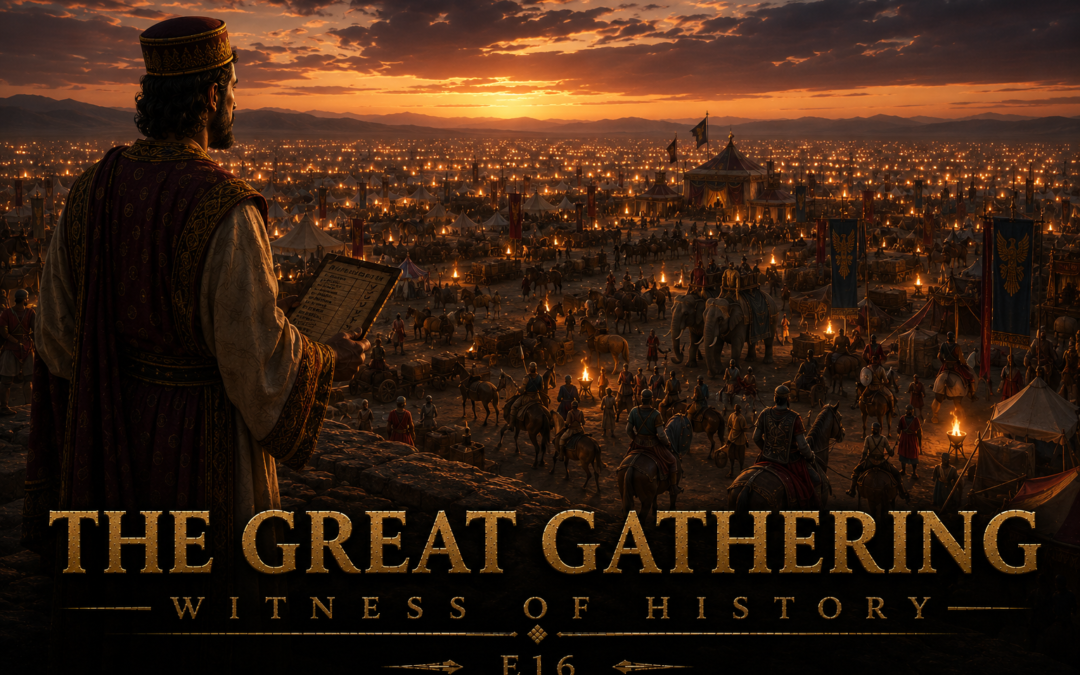
How did Darius III rebuild the Persian war effort after Issus? Through the eyes of a royal inspector traveling across the Achaemenid Empire, witness the extraordinary mobilization that brought Medes, Armenians, Babylonians, Bactrians, Saka horsemen, eastern troops, and war elephants toward one battlefield. This immersive historical podcast explores Persian administration, logistics, loyalty, and the vast imperial machine gathering for the Battle of Gaugamela against Alexander the Great.
Narrator: Artadata, Persian Royal Inspector
Setting: Across the Persian Empire, 331 BCE
Historical Sources
Ancient Sources
- Arrian, Anabasis of Alexander (Book III)
- Darius III's preparations before Gaugamela.
- The multinational composition of the Persian army.
- The presence of Bactrian cavalry, Saka cavalry, Indian contingents, and fifteen Indian elephants.
- The leveling of the battlefield in preparation for cavalry and scythed chariots.
- Diodorus Siculus, Library of History (Book XVII)
- The gathering of forces from across the Persian Empire.
- Descriptions of the immense size and diversity of Darius' army.
- Persian military preparations before Gaugamela.
- Quintus Curtius Rufus, History of Alexander (Books IV–V)
- The organization of the Persian camp.
- Darius' leadership and preparations.
- Descriptions of the multinational army and the atmosphere before the battle.
- Plutarch, Life of Alexander
- Characterization of Darius III.
- Preparations leading to Gaugamela.
- Alexander's and Darius' contrasting approaches before the battle.
- Herodotus, Histories (Books III, V, VIII)
- The organization of the Achaemenid Empire.
- The Royal Road.
- The satrapal system.
- The King's inspectors ("The King's Eyes and Ears").
- Persian concepts of kingship and administration that continued into the Achaemenid period.
- The Behistun Inscription of Darius I
- Persian royal ideology.
- The concepts of Truth (Arta/Asha) versus the Lie (Drauga).
- The king's role in restoring order throughout the empire.
Modern Sources
- Adrian Goldsworthy, Philip and Alexander
- Darius' military reforms after Issus.
- The strategic preparations for Gaugamela.
- Composition of the Persian army.
- The choice and preparation of the battlefield.
- Peter Green, Alexander of Macedon, 356–323 B.C.
- Persian administration after Issus.
- The rebuilding of Darius' army.
- Eastern contingents and cavalry.
- Persian strategic planning before Gaugamela.
- Robin Lane Fox, Alexander the Great
- The organization of the Persian Empire.
- The campaign leading to Gaugamela.
- The multinational nature of Darius' forces.
- Philip Freeman, Alexander the Great
- The mobilization of the Persian Empire.
- Darius III's preparations.
- Persian leadership and administration.
- Pierre Briant, From Cyrus to Alexander: A History of the Persian Empire
- Achaemenid administration.
- Satrapal government.
- Royal inspectors.
- Persian ideology of kingship.
- The Royal Road.
- Imperial logistics and communications.
- The political and administrative structure that allowed Darius to assemble another massive army after Issus.
Author's Notes
Historical
- Artadata is portrayed as one of the royal inspectors ("The King's Eyes"), officials described by Greek sources as traveling the empire to inspect satraps, verify loyalty, and report directly to the Great King. While the exact duties of individual inspectors are not fully known, the role itself is historically well attested.
- The episode's central themes of truth, order, and duty are inspired by Achaemenid royal ideology, especially the concepts of Arta (Asha) and Drauga (the Lie) found in the inscriptions of Darius I. Although these ideas are never explained explicitly by the narrator, they shape his worldview throughout the episode.
- Following the Battle of Issus, Darius III successfully reassembled a vast multinational army by drawing upon the administrative and logistical strength of the Achaemenid Empire. Modern historians emphasize that the empire remained highly functional despite Alexander's victories.
- The provincial contingents described in the episode, including Persian and Median nobles, Armenian cavalry, Babylonian logistical support, Bactrian cavalry, Saka horsemen, and troops from the eastern satrapies with approximately fifteen Indian elephants, are based on the ancient descriptions of Darius' army before Gaugamela.
- The preparation of the battlefield, including clearing and leveling the ground for cavalry and scythed chariots, is recorded by Arrian and reflects Darius' deliberate planning before the battle.
- Darius III is intentionally portrayed as an active and capable ruler organizing one of the largest military mobilizations of the ancient world, reflecting the reassessment offered by many modern historians rather than the older literary tradition that presents him simply as a weak or passive king.
Reconstructed
- Artadata and his personal story are fictional.
- The opening story of the missing twenty horses is an original reconstruction designed to illustrate the responsibilities of a royal inspector and the Persian emphasis on truthful reporting.
- The inspections of individual provinces, conversations with local officials, and observations during the journey are fictional but are intended to represent the administrative realities of the Achaemenid Empire.
- The recurring motif of "Remembered" is a literary device symbolizing the restoration of imperial order after Issus.
- The dialogue with the older inspector, the climb overlooking the sea of campfires, and Artadata's reflections are fictional scenes created to express the confidence many Persians may have felt after witnessing the empire's remarkable mobilization before Gaugamela.
- The episode seeks to portray the Persian Empire from a Persian perspective, emphasizing administration, duty, truth, and unity rather than viewing the events solely through Alexander's campaign. The goal is not to foreshadow defeat, but to allow listeners to experience the confidence and hope that likely accompanied the greatest gathering of Achaemenid power before the Battle of Gaugamela.