
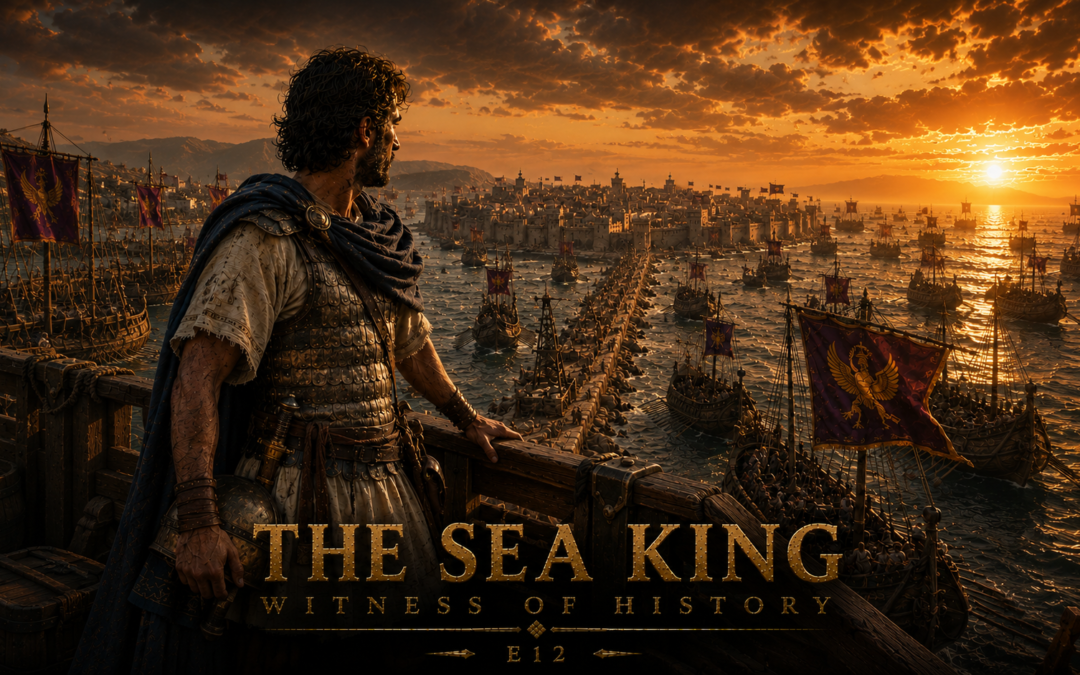
Alexander has built a road across the sea but the Siege of Tyre is far from over. Through the eyes of a Phoenician sailor serving in Alexander's fleet, experience the naval blockade, the devastating fireship attack, and the final assault that brought the ancient island fortress to its knees. This immersive historical podcast explores the fall of Tyre, the power of persistence, and the human cost of one of the greatest sieges in military history, as Alexander the Great turns his gaze toward Gaza and then Egypt.
Narrator: Hanno, Phoenician sailor serving in Alexander's fleet
Setting: Siege of Tyre, 332 BCE
1. Historical Sources
a. Ancient Sources
- Arrian, Anabasis of Alexander
- Diodorus Siculus, Library of History
- Curtius Rufus, History of Alexander
- Plutarch, Life of Alexander
- Justin, Epitome of Pompeius Trogus
b. Modern Sources
- Adrian Goldsworthy, Philip and Alexander
- Philip Freeman, Alexander the Great
- Robin Lane Fox, Alexander the Great
- Peter Green, Alexander of Macedon, 356–323 BC
- Donald W. Engels, Alexander the Great and the Logistics of the Macedonian Army
- James Romm (ed.), The Landmark Arrian
2. Author's Notes
a. Historical
- Following the Battle of Issus, most of the Phoenician cities, including Sidon and Byblos, submitted to Alexander and provided ships for his campaign.
- The defection of the Phoenician and Cypriot fleets deprived Tyre of its naval superiority and gave Alexander overwhelming control of the eastern Mediterranean.
- The arrival of these fleets transformed the siege from a primarily engineering operation into a combined land-and-sea assault.
- The Tyrians launched a fireship attack that destroyed Macedonian siege towers and damaged sections of the causeway.
- Alexander rebuilt his siege works and continued the siege despite repeated setbacks.
- The Macedonian fleet blockaded Tyre's harbors, limiting the city's ability to receive supplies or reinforcements.
- During the final assault, Macedonian forces breached the southern walls while allied fleets attacked from the sea.
- After approximately seven months of resistance, Tyre was captured in 332 BCE following fierce fighting.
- Ancient sources report that thousands of Tyrians were killed during the capture of the city, while many others were sold into slavery.
- Alexander offered a sacrifice to Melqart after the city's capture, fulfilling the purpose for which he had originally requested entry into Tyre.
- With Phoenicia secured, Alexander marched south toward Gaza and then into Egypt, where he encountered little organized resistance.
b. Reconstructed
- Hanno, the Phoenician sailor from Sidon serving in Alexander's fleet.
- His wife, son, family life, and longing to return home.
- Conversations among sailors throughout the siege.
- The narrator learning about his family through arriving merchant ships.
- Personal observations of the growing causeway and the changing mood within the fleet.
- The emotional reactions aboard the ships during the fireship attack.
- The narrator's experience during the final naval assault.
- The encounter with the frightened young Tyrian defender on the breached wall.
- The narrator's reflections on how victory quickly becomes ordinary for soldiers.
- Alexander studying maps and discussing Egypt immediately after the fall of Tyre.
- The concluding contrast between ordinary people, whose lives are transformed by a single siege, and Alexander, whose attention had already turned toward his next campaign.
This episode concludes the Tyre storyline through the eyes of a man whose greatest wish was simply to return home, highlighting the contrast between ordinary lives and Alexander's relentless drive toward the next horizon.