
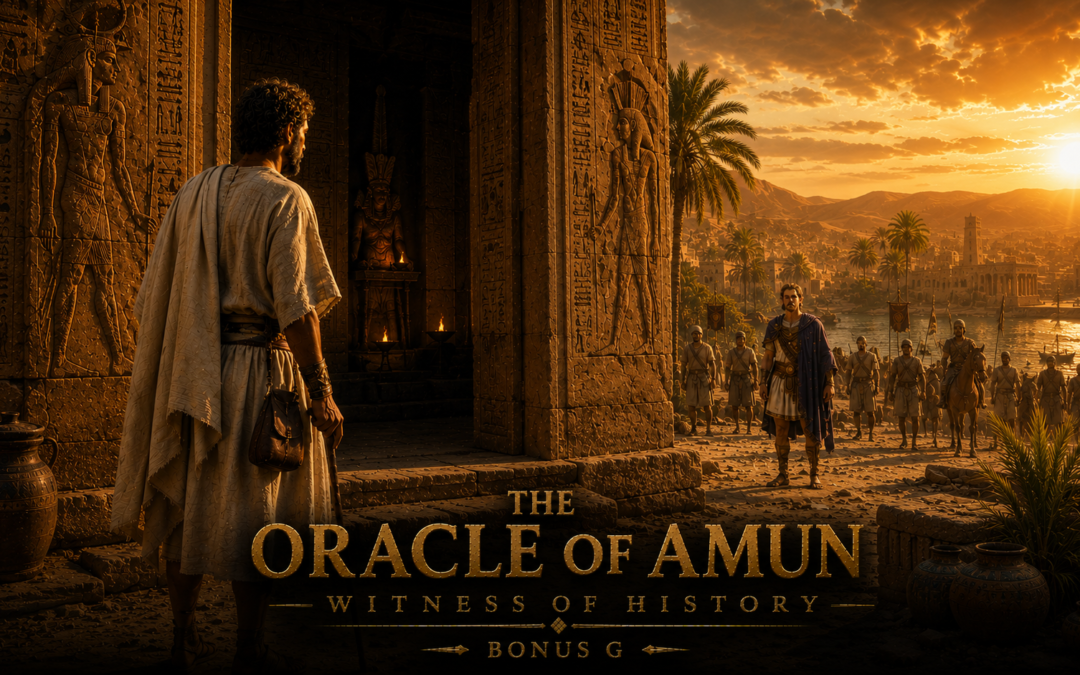
Why did Alexander the Great cross the Western Desert to consult the Oracle of Amun at Siwa? Through the eyes of a caravan guide, experience the dangerous journey from Egypt’s coast into the Sahara, where certainty gives way to fear, mystery, and awe. This immersive historical podcast explores Alexander’s search for divine answers, the ancient Oracle of Amun, and the unanswered question at the heart of one of the most enigmatic episodes of his life.
Narrator: Nekhtamun, frontier caravan guide from Paraetonium
Setting: Journey to Siwa Oasis, 331 BCE
1. Historical Sources
a. Ancient Sources
- Arrian, Anabasis of Alexander
- Plutarch, Life of Alexander
- Diodorus Siculus, Library of History
- Curtius Rufus, History of Alexander
- Strabo, Geography
- Herodotus, Histories (Book II – the Oracle of Amun at Siwa)
b. Modern Sources
- Robin Lane Fox, Alexander the Great
- Peter Green, Alexander of Macedon, 356–323 BC
- Philip Freeman, Alexander the Great
- Adrian Goldsworthy, Philip and Alexander
- Paul Cartledge, Alexander the Great: The Hunt for a New Past
2. Author's Notes
a. Historical
- In 331 BCE, after securing Egypt and founding Alexandria, Alexander deliberately left the main campaign to journey across Egypt's Western Desert to consult the Oracle of Amun at Siwa.
- Alexander first traveled to Paraetonium (modern Mersa Matruh), where he received envoys from Cyrene before turning south toward Siwa.
- The Oracle of Amun was already renowned throughout Egypt and the Greek world centuries before Alexander's visit. Herodotus described the oracle, and Greek tradition associated it with figures such as Heracles, Perseus, and later Lysander of Sparta.
- Ancient sources record that Alexander's journey through the desert became difficult and that the expedition temporarily lost its way.
- Different ancient authors preserve different traditions explaining how the expedition reached Siwa, including rainfall, ravens guiding the travelers, and serpents leading the way. Modern historians cannot determine which, if any, of these accounts are historical.
- The exact conversation between Alexander and the priests of Amun has never been reliably recorded. Ancient authors preserve several traditions, but none can be confirmed with certainty.
- Ancient writers generally agree that Alexander emerged from Siwa with noticeably greater confidence and that the visit became one of the defining moments in the development of his legend.
- The Gordian Knot prophecy, declaring that whoever solved the knot would become lord of Asia, had already become associated with Alexander before the journey to Siwa and forms an important historical context for understanding why his companions may have questioned the need for another oracle.
b. Reconstructed
- Nekhtamun, the frontier caravan guide from Paraetonium.
- His family history as generations of desert guides, including the tradition that his great-grandfather guided a famous Spartan commander to the Oracle of Amun.
- The conversations with his father concerning why guides never entered the temple.
- The father's philosophy that guides lead travelers to destinations rather than to answers.
- The dialogue between Nekhtamun and one of Alexander's Companions discussing Gordium and Alexander's motives for visiting Siwa.
- Nekhtamun's internal struggle over whether to enter the temple himself.
- The personal observations of Alexander's behavior during the journey and after leaving the temple.
- The final conversation between Nekhtamun and Alexander.
- The symbolic ending in which Nekhtamun chooses not to enter the temple, realizing that he has not yet found a question worthy of asking.