
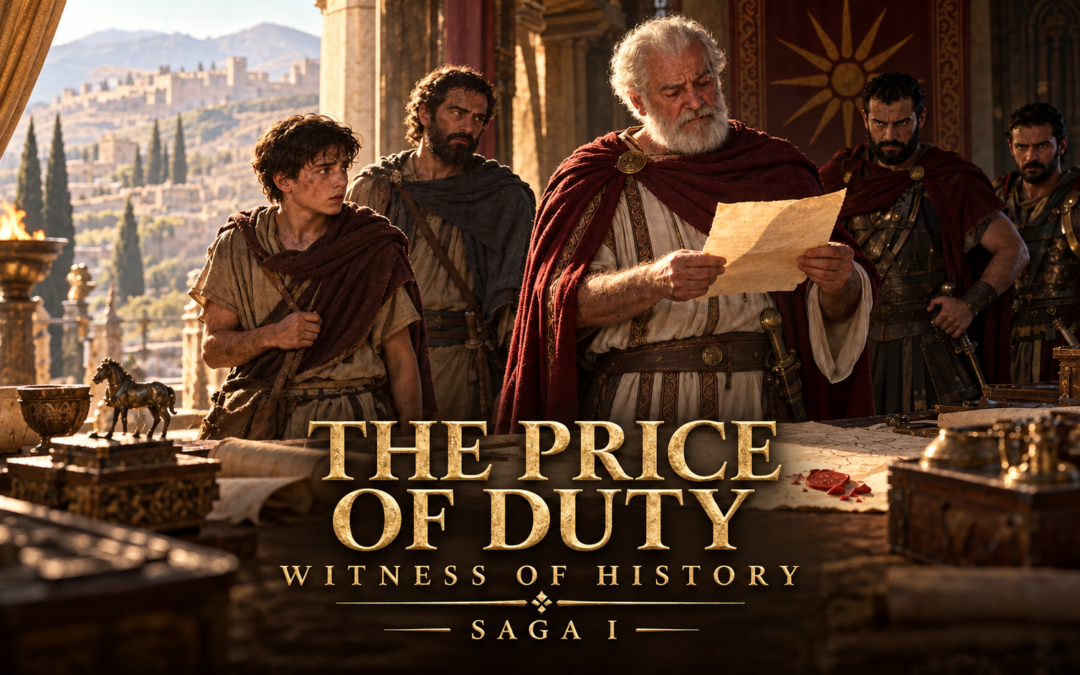
What does duty cost when obedience becomes complicity? Through the eyes of Damon, a young royal courier in Alexander’s army, witness the Philotas affair and the secret mission that carries Alexander’s orders across hundreds of miles to Parmenion in Ecbatana. What begins as the greatest assignment of Damon’s life slowly becomes something far darker.
This immersive historical fiction podcast explores loyalty, secrecy, responsibility, and the machinery that allows kings to act across an empire. As Damon discovers that a courier can change history without ever drawing a sword, he is left with a question that follows him for the rest of his life: what is the difference between committing an act and carrying the order that makes it happen?
Narrator: Damon, Former Royal Courie
Setting: From Alexander's camp in Drangiana to Ecbatana, 330 BCE
1. Sources
a. Ancient Sources
- Arrian, Anabasis of Alexander, Book III, Chapters 26 to 27
- Philotas' arrest and execution.
- The uncertainty surrounding his actual involvement in the assassination plot.
- Parmenion's death following the execution of his son. Arrian's own tradition treats Philotas as guilty, although the evidence he preserves is less certain.
- Quintus Curtius Rufus, History of Alexander, Book VI, Chapters 7 to 11
- The fullest surviving narrative of the Philotas affair.
- The discovery of Dimnus' conspiracy.
- Philotas' failure to report the plot.
- His interrogation, torture, trial and execution.
- Alexander's secret dispatch of Polydamas to Ecbatana.
- Polydamas travelling with two Arab guides, the secret orders to Cleander, and the assassination of Parmenion.
- Diodorus Siculus, Library of History, Book XVII, Chapters 79 to 80
- Philotas' torture, confession and execution.
- Parmenion's position at Ecbatana and his control of the royal treasure.
- Alexander sending men on racing camels so that news of Philotas' death could not reach Parmenion first.
- Plutarch, Life of Alexander, Chapters 48 to 49
- The Philotas affair, Alexander's suspicions, the treatment of Philotas, and the wider political atmosphere surrounding Parmenion's death.
- Justin, Epitome of Pompeius Trogus, Book XII
- A later summary of the destruction of Philotas and Parmenion and the fear their deaths caused among Alexander's senior commanders.
b. Modern Sources
- Peter Green, Alexander of Macedon, 356 to 323 B.C.
- Used extensively for the reconstruction of Polydamas' mission.
- Green follows the tradition that Polydamas travelled disguised, accompanied by two Arab guides, and reached Ecbatana in only eleven days rather than the normal thirty.
- He also describes the letters used to approach Parmenion and Cleander's role in the killing.
- Adrian Goldsworthy, Philip and Alexander: Kings and Conquerors
- Used for the political and military context of the Philotas affair, Parmenion's extraordinary position within Alexander's command, and the growing transformation of Alexander's kingship.
- A. B. Bosworth, Conquest and Empire: The Reign of Alexander the Great
- Used for the evidence surrounding Philotas' guilt, the Macedonian political context, and Alexander's reasons for regarding Parmenion as a potential threat.
- F. W. Walbank, The Hellenistic World
- Used for the broader transition after Darius' death and Parmenion's position at Ecbatana, where he controlled communications while Harpalus oversaw the treasury.
2. Author's Notes
a. Historical
- In 330 BCE, while Alexander was in Drangiana, a conspiracy against his life was uncovered. Philotas, son of Parmenion and commander of the Companion cavalry, was accused primarily because he had learned of the plot but failed to report it promptly to Alexander.
- Philotas' actual involvement in the assassination conspiracy remains uncertain. The surviving evidence clearly supports his failure to report what he had heard, but does not securely prove that he participated in Dimnus' plot.
- Philotas was arrested, brought before the Macedonian army, interrogated and executed. Several ancient sources report that he was tortured before his death.
- His father Parmenion was hundreds of miles away at Ecbatana. He was one of Macedonia's most experienced commanders, had served Philip II before Alexander, and controlled substantial forces and strategically important resources in Media.
- Alexander decided that Parmenion could not safely be informed of his son's execution before action was taken against him. Whether Parmenion himself had participated in any conspiracy is not established by the surviving evidence.
- Polydamas was historical. Alexander secretly sent him to Ecbatana carrying orders for Parmenion's death. The tradition preserved through Curtius describes him travelling in disguise with two Arab guides and reaching Ecbatana in only eleven days.
- Polydamas first contacted Cleander, one of the Macedonian commanders at Ecbatana. Cleander and other officers then carried out Alexander's order.
- The ancient tradition says Polydamas brought letters for Parmenion so that his arrival would appear normal. One was from Alexander and another reportedly carried Philotas' seal. Parmenion was reading the letters when the attack began.
- Parmenion was killed before news of Philotas' execution could reach him. His death remains one of Alexander's most controversial acts because no secure evidence survives demonstrating Parmenion's personal involvement in the conspiracy.
b. Reconstructed
- Damon is fictional. His role as a young royal courier accompanying Polydamas, and the episode's journey from Drangiana to Ecbatana through his eyes, were created for the story.
- Damon's apprenticeship under Polydamas, their friendship, conversations and the idea that Polydamas personally trained him are fictional.
- The episode's horse relay system, exhausted mounts, relay stations and riding experiences are reconstructed. The surviving tradition instead specifically describes Polydamas' party travelling rapidly on racing camels with Arab guides.
- Damon's presence when Philotas is brought from interrogation, and his observations of Philotas' injuries, are fictional.
- The precise assassination scene is reconstructed. Ancient tradition places Parmenion's death during his meeting with Polydamas and Cleander, but the episode adapts the location, dialogue and sequence for Damon's perspective.
- Damon's belief that the letter itself was designed merely to hold Parmenion's attention is an interpretation of the ancient story, not something stated directly by the sources.
- Damon's guilt over whether carrying an order makes him morally responsible for its consequences is the fictional heart of the Saga.
- Damon's later departure from royal service, his career as a potter, his granddaughter, and the conversations surrounding the pottery wheel are entirely fictional.
- The recurring symbols of the letter, the exhausted horses and the clay are fictional devices used to explore duty, obedience and personal responsibility.
- The episode deliberately leaves the guilt of Philotas and Parmenion unresolved. The historical evidence does not allow us to know with certainty how much Philotas knew beyond his failure to report the plot, or whether Parmenion knew anything about it at all.