
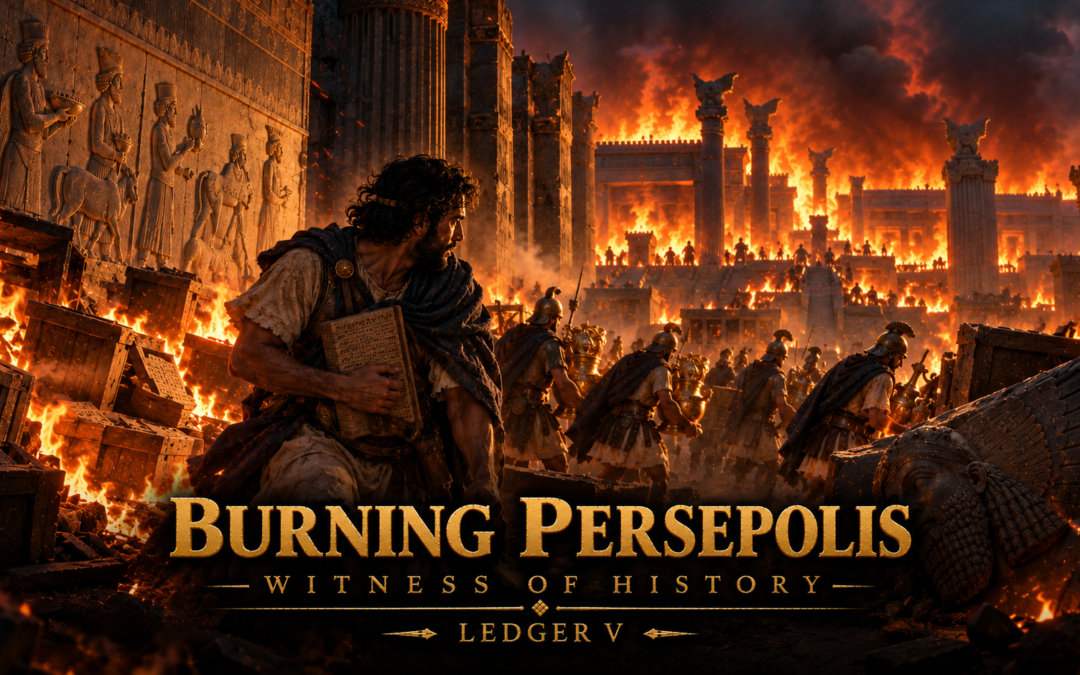
What is lost when a civilization burns? Through the eyes of Menon, a Macedonian treasury clerk who has spent Alexander's campaign counting casualties, supplies, ships, tribute, and treasure, witness the capture and burning of Persepolis from the perspective of a man who discovers something numbers cannot measure. This immersive historical podcast explores the extraordinary wealth of the Persian capital, its monumental art and administrative records, and the human civilization hidden behind the Greek idea of “the enemy” asking whether the true cost of destruction can ever be entered into a ledger.
Narrator: Menon, fictional Macedonian clerk attached to the royal treasury
Setting: Persepolis, Persis, winter/spring 330 BCE
1. Sources
a. Ancient Sources
- Arrian, Anabasis of Alexander, Book 3.18
- Alexander’s advance through the Persian Gate and arrival in the region of Persepolis.
- Provides the wider military context immediately preceding the occupation of the Persian capital.
- Diodorus Siculus, Library of History, Book 17.70 to 72
- One of the fullest surviving accounts of the capture and destruction of Persepolis.
- Describes the immense wealth of the city, Macedonian plundering, and the royal treasury accumulated from the reign of Cyrus onward. Diodorus gives the famous figure of 120,000 talents for the treasure.
- Also preserves the tradition of the drinking celebration and the decision to burn the palace.
- Plutarch, Life of Alexander, 38
- Preserves the famous tradition that Thais, during a drinking party, urged Alexander to burn the palace in revenge for Xerxes’ destruction in Greece.
- Also reflects the ancient debate over whether the burning was a drunken impulse or a deliberate act.
- Quintus Curtius Rufus, History of Alexander, Book 5.6 to 7
- Provides another detailed version of Alexander at Persepolis, the enormous wealth captured there, the banquet, Thais, and the burning of the royal palace.
- Particularly important for the dramatic tradition surrounding the fire.
- Strabo, Geography, Book 15
- Provides additional evidence for Persepolis, its royal importance, its wealth, and Alexander’s destruction of the palace.
b. Modern Sources
- Adrian Goldsworthy, Philip and Alexander: Kings and Conquerors
- Used for the wider campaign narrative, Alexander’s occupation of Persepolis, the significance of the royal center, and modern discussion of the burning.
- Philip Freeman, Alexander the Great
- Used for Alexander’s arrival at Persepolis, the monumental character of the palace complex, its reliefs, royal buildings, treasury, and the destruction that followed.
- Freeman describes Persepolis as a monumental expression of Achaemenid imperial power, including the great stairways and reliefs depicting the peoples of the empire.
- Peter Green, Alexander of Macedon, 356 to 323 B.C.: A Historical Biography
- Used for the campaign chronology and interpretation of Alexander’s actions at Persepolis, including the political and symbolic dimensions of the destruction.
- A. B. Bosworth, Conquest and Empire: The Reign of Alexander the Great
- Used for the historical context of Alexander’s conquest of the Achaemenid Empire and the interpretation of his behavior at Persepolis.
- Pierre Briant, From Cyrus to Alexander: A History of the Persian Empire
- Used for the Persian perspective, Achaemenid royal administration, Persepolis, and the importance of understanding the site as an imperial and administrative center rather than simply a storehouse of treasure.
- Persepolis Fortification and Treasury Tablet scholarship
- Archaeological work on the surviving administrative tablets was important for understanding the enormous bureaucratic system behind Persepolis and the ordinary workers, officials, payments, rations, movements, and transactions recorded there.
2. Author’s Notes
a. Historical
- Persepolis was one of the great royal centers of the Achaemenid Empire. Its monumental architecture and reliefs deliberately presented the scale and diversity of Persian imperial rule.
- Alexander captured an extraordinary royal treasury there. Ancient figures should be treated cautiously, but there is no doubt that the amount was enormous. Diodorus gives a figure of 120,000 talents and describes the treasure as accumulated from the revenues of Persian kings beginning with Cyrus.
- Persepolis was violently plundered. Diodorus describes Macedonian troops looting houses, seizing gold, silver and luxury goods, enslaving women, and even fighting among themselves over the spoils.
- Alexander later burned the royal palace complex. The surviving sources disagree about his motivation. The famous tradition associates the fire with a drinking party, Thais, and revenge for Xerxes’ destruction in Greece. Whether the burning was primarily spontaneous, symbolic, political, or some combination remains debated.
- Persepolis really was an administrative world of records. Thousands of surviving Fortification and Treasury tablets reveal an extensive bureaucracy concerned with workers, rations, payments, travel, livestock, supplies, and administration. The episode uses this evidence to show Menon discovering Persia through the records of ordinary administration.
b. Reconstructed
- Menon is a fictional treasury clerk, and his presence at Persepolis is part of our continuing reconstruction of his life within Alexander’s administrative world.
- Menon personally exploring and becoming attached to the archives is reconstructed. His changing perception of Persia is the emotional framework of the episode.
- Menon running toward the records during the fire and rescuing a single ledger is fictional. It symbolizes the survival of ordinary human lives through administrative records.
- The forty-three or forty-four days spent counting the treasure is fictional. The enormous scale of the captured wealth and the logistical challenge of moving it are historical, but we do not know how long individual clerks spent inventorying it.
- The surviving Persepolis tablets should not be imagined as one archive simply consumed in Alexander’s fire. Ironically, the destruction helped preserve some clay tablets by baking them. The episode’s burning archive is therefore a dramatic reconstruction representing the wider destruction and loss of records, not an explanation for the archaeological survival of the tablets.