
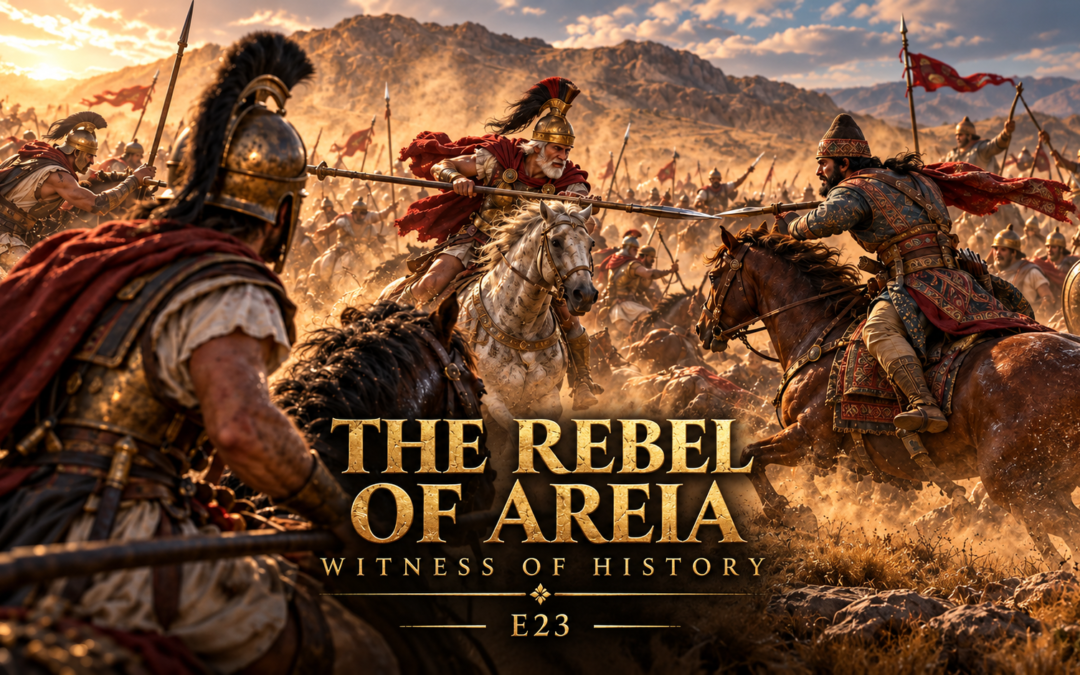
The first time Satibarzanes betrayed Alexander, the king turned his army around and raced roughly seventy-five miles in two days to catch him. Satibarzanes escaped. The second time, Alexander did not bother coming himself.
Through the eyes of Mikkos, a Macedonian cavalryman who takes part in both campaigns, follow one of the most frustrating rebellions of Alexander’s eastern conquest: Satibarzanes’ submission, his sudden revolt and killing of the Macedonian force left behind, Alexander’s extraordinary forced march back into Areia, and the rebel satrap’s escape only for him to return and rebel again.
This immersive historical podcast explores the brutal speed of Alexander’s campaigns, the exhaustion of the men and horses who carried them out, the difficulties of ruling conquered Persian provinces, and Satibarzanes’ final confrontation with the veteran Macedonian commander Erigyius.
For Mikkos, killing the man they had hunted twice brings satisfaction, but also an increasingly uncomfortable realization: in the east, finishing one pursuit only seemed to reveal another.
Narrator: Mikkos, Macedonian cavalryman
Setting: Areia, 330–329 BCE
1. Sources
a. Ancient Sources
- Arrian, Anabasis of Alexander, Book III, 3.25
- Satibarzanes' submission to Alexander and confirmation as satrap of Areia.
- Alexander leaving Anaxippus with about forty mounted javelin men in the province.
- Satibarzanes killing Anaxippus and his men and raising Areia in revolt.
- Alexander immediately turning back with Companion cavalry, mounted javelin troops, archers, Agrianians and selected infantry.
- The remarkable forced march of nearly seventy-five miles in two days to Artacoana.
- Satibarzanes fleeing when he learned how quickly Alexander was approaching.
- Arrian, Anabasis of Alexander, Book III, 3.28
- Satibarzanes' second revolt after returning to Areia with approximately 2,000 cavalry supplied by Bessus.
- Alexander sending Artabazus, Erigyius and Caranus against him while continuing east.
- The hard-fought battle in Areia.
- Erigyius killing Satibarzanes in personal combat by striking him in the face with his spear.
- The collapse and flight of Satibarzanes' forces after his death.
- Quintus Curtius Rufus, History of Alexander, Book VI
- Satibarzanes' revolt and Alexander's rapid return to Areia.
- Satibarzanes fleeing toward Bactria with cavalry.
- The rebels taking refuge on a steep, wooded height.
- Alexander using fire against the position, with many defenders killed by flames, falls or Macedonian soldiers.
- Curtius provides much of the basis for the episode's particularly brutal fire sequence.
- Diodorus Siculus, Library of History, Book XVII, Chapters 78 and 81 to 82
- Satibarzanes killing the Macedonian troops left with him and joining Bessus' resistance.
- His flight from Alexander's first counterattack.
- His later return to Areia.
- The fighting preceding the final battle.
- Satibarzanes openly challenging the Macedonian commanders to single combat.
- Erigyius accepting the challenge and killing him, after which the remaining rebels surrendered.
b. Modern Sources
- Adrian Goldsworthy, Philip and Alexander: Kings and Conquerors
- Used for the wider military context of Alexander's eastern campaigns, cavalry operations, forced movement, horse management and the physical demands placed on Alexander's mounted troops.
- Peter Green, Alexander of Macedon, 356-323 B.C.: A Historical Biography
- Used for the chronology of Alexander's movement through the eastern satrapies and the political problems created by repeated revolts after Darius' death.
- A. B. Bosworth, Conquest and Empire: The Reign of Alexander the Great
- Used for Alexander's developing administration of the former Persian Empire, his reliance on Persian satraps and the difficulties of maintaining control while the army continued moving east.
- Philip Freeman, Alexander the Great
- Used for the narrative context of the pursuit of Bessus, the eastern campaigns and Alexander's reliance on extraordinary speed to deal with threats behind and ahead of the army.
2. Author's Notes
a. Historical
- Satibarzanes was the Persian satrap of Areia and had been among the men involved in Darius III's final downfall. After Darius' death, he submitted to Alexander and was initially allowed to remain governor of his province.
- Alexander left Anaxippus and about forty mounted javelin men with Satibarzanes. The episode simplifies them as cavalrymen. Satibarzanes later killed this force and raised Areia in revolt.
- Alexander's response was extraordinarily fast. Arrian records that he turned back with a selected mobile force and covered nearly seventy-five miles in two days before reaching Artacoana.
- Satibarzanes escaped before Alexander could catch him. Ancient accounts differ in some details of his flight and the forces accompanying him.
- The destruction of rebels on a wooded mountain position by fire comes from Curtius. Arrian gives a different and less elaborate account of Alexander suppressing the first rebellion.
- After the revolt, Alexander again entrusted Areia to a Persian satrap, demonstrating that one betrayal did not cause him to abandon his broader policy of governing much of the former Achaemenid Empire through local elites.
- Satibarzanes later returned with approximately 2,000 cavalry from Bessus and raised Areia in rebellion for a second time.
- Alexander did not return personally. He continued his eastern campaign and sent commanders including Artabazus, Erigyius and Caranus against Satibarzanes.
- The death of Satibarzanes in single combat with Erigyius is ancient tradition. Arrian says Erigyius struck him in the face with his spear, while Diodorus presents the encounter more dramatically as a formal challenge between commanders.
b. Reconstructed
- Mikkos is fictional. His participation in both campaigns, his place within the cavalry and his personal memories of the events are reconstructed.
- Mikkos knowing some of the men killed with Anaxippus is fictional and gives the first revolt a personal motive beyond military duty.
- The detailed experience of the forced march, including exhausted horses, thirst, brief rests, sleeping in the saddle and Mikkos fearing his horse will collapse, is reconstructed from the conditions of rapid mounted campaigning.
- Mikkos' belief that Alexander drove men forward partly through shame at stopping while the king continued is an interpretation of Alexander's leadership style, not a statement preserved from an individual soldier.
- Mikkos witnessing the burning of the rebels from below and reacting with "There was no glory in it" is fictional, although the fire attack itself comes from ancient tradition.
- His presence in the second expedition under Erigyius and his witnessing of Satibarzanes' final fight are reconstructed.
- The episode combines the surviving versions of the final combat cautiously. Erigyius killing Satibarzanes is historical tradition, but the precise movements, what each man saw and how nearby soldiers experienced the duel cannot be recovered.
- Satibarzanes' severed head being treated by Mikkos as tangible proof of his death is a dramatic reconstruction around the ancient practice of using severed heads as confirmation of the death of important enemies.
- Mikkos' satisfaction that the pursuit is finally finished, followed by his unease that Alexander is already chasing another enemy farther east, is the episode's fictional emotional arc. It reflects the historical reality that the defeat of Satibarzanes did not end the eastern campaigns.