
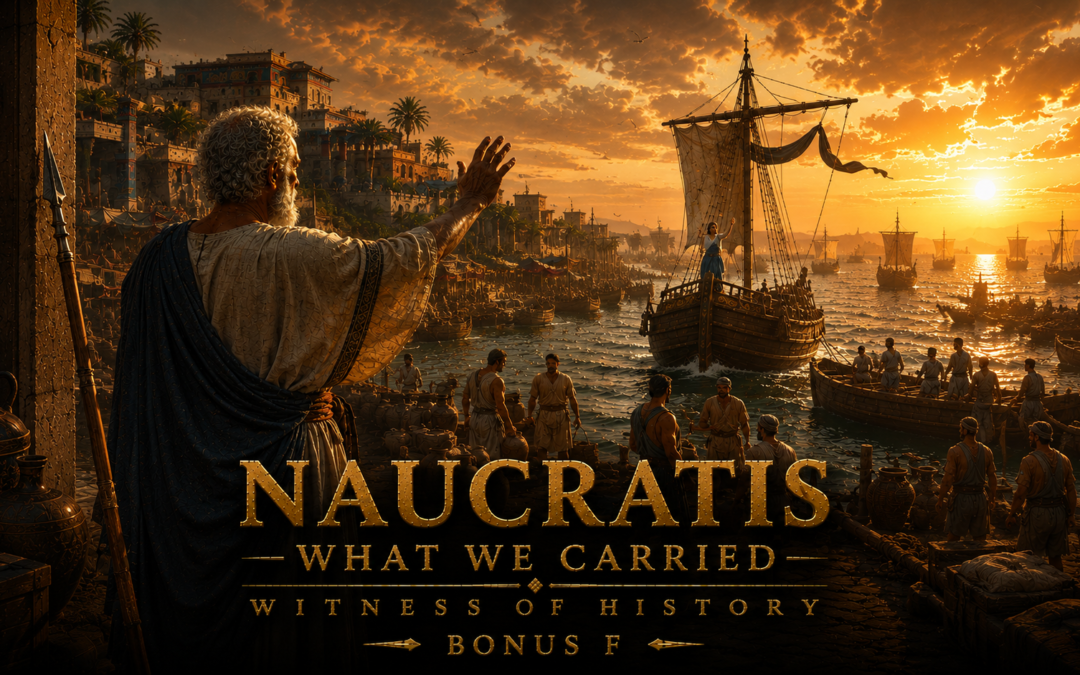
What do families carry across generations? Through the eyes of Sostratos, an elderly merchant of Naucratis, discover the story of a Greek family that crossed the Mediterranean centuries before Alexander arrived in Egypt. This episode explores migration, identity, the founding of Naucratis, and the quiet choices that shape generations, revealing that the greatest inheritance is not a spear, a city, or a homeland, but the love and hope that compel people to cross the sea in search of a better future.
Narrator: Sostratos, Merchant of Naucratis
Setting: Naucratis, Egypt — 332 BCE
1. Historical Sources
A. Ancient Sources
- Herodotus, Histories (Book II)
- Strabo, Geographica (Book XVII)
- Diodorus Siculus, Library of History (Book I & XVII)
- Arrian, Anabasis of Alexander (Book III)
- Plutarch, Life of Alexander
- Athenaeus, Deipnosophistae
B. Modern Sources
- Boardman, John. The Greeks Overseas: Their Early Colonies and Trade. Thames & Hudson.
- Möller, Astrid. Naukratis: Trade in Archaic Greece. Oxford University Press.
- Bresson, Alain. The Making of the Ancient Greek Economy. Princeton University Press.
- Lloyd, Alan B. Herodotus Book II: Commentary. Brill.
- Fraser, P. M. Ptolemaic Alexandria. Oxford University Press. (Used primarily for background on the earlier Greek communities that preceded Alexandria.)
- Green, Peter. Alexander of Macedon, 356–323 BC: A Historical Biography. University of California Press.
- Lane Fox, Robin. Alexander the Great. Penguin Books.
- Worthington, Ian. By the Spear: Philip II, Alexander the Great, and the Rise and Fall of the Macedonian Empire. Oxford University Press.
- Casson, Lionel. The Ancient Mariners. Princeton University Press. (For Mediterranean shipping, merchant life, and harbors.)
- Hansen, Mogens Herman. An Inventory of Archaic and Classical Poleis. Oxford University Press.
2. Author’s Notes
A. Historical
- Greek migration during the Archaic period was driven by multiple factors including population growth, limited agricultural land, inheritance customs affecting younger sons, expanding trade opportunities, and military service abroad. No single explanation applies to every migrant.
- Egyptian pharaohs, beginning with Psamtik I in the 7th century BCE, recruited Greek and Carian mercenaries. Many eventually settled in Egypt after completing their service.
- Naucratis became the first officially recognized permanent Greek trading settlement in Egypt, particularly under Pharaoh Amasis II during the 6th century BCE. It served as a major commercial and cultural bridge between Greece and Egypt.
- Archaeological and literary evidence confirms that Naucratis was a multicultural port inhabited by Greeks from numerous city-states alongside Egyptians, Phoenicians, Carians, Cypriots, and other Mediterranean peoples.
- The Hellenion, a shared sanctuary founded by several Greek cities, illustrates how communities that often competed in Greece cooperated abroad.
- Intermarriage between Greeks and non-Greeks almost certainly occurred in Naucratis and elsewhere in Egypt, although the extent varied across generations and social groups.
- By Alexander’s arrival in Egypt in 332 BCE, Greek communities had already lived in Egypt for roughly three centuries. Alexander entered a land where Greek merchants, soldiers, artisans, and their descendants were already an established part of society.
- Ancient sources describe Alexander as respecting Egyptian religious traditions, participating in local ceremonies, and being accepted as Pharaoh by the Egyptian priesthood.
B. Reconstructed
The following elements are fictional but designed to represent historically plausible experiences:
- Sostratos, his granddaughter, and the family’s genealogy are fictional.
- The ancestor’s journey from Miletus as a younger son who first served as a mercenary before becoming a merchant reflects a historically plausible path documented for many Greeks in Egypt, though this specific family is fictional.
- The family tradition that “he put down the spear when he carried his son” is symbolic and created for the narrative.
- The evening walk through Naucratis, the conversations between Sostratos and his granddaughter, the bread-making scene, and the packing scene are fictional reconstructions intended to illustrate everyday life within a multicultural Greek-Egyptian household.
- The unnamed Macedonian soldier represents the thousands of ordinary soldiers who entered Egypt with Alexander. His conversation with Sostratos is fictional but constructed to mirror the hopes and uncertainties that many young soldiers likely carried.
- The dialogue surrounding identity, memory, and inheritance is entirely fictional, although it is inspired by the historical realities of migration, cultural integration, and family continuity across generations.
- The central metaphor of “What We Carried” is an artistic device. While the physical spear symbolizes the family’s origins, the episode ultimately explores the intangible inheritance of love, sacrifice, memory, and hope passed from one generation to the next. Although these conversations are imagined, they reflect questions that countless migrant families, ancient and modern, have likely faced.