
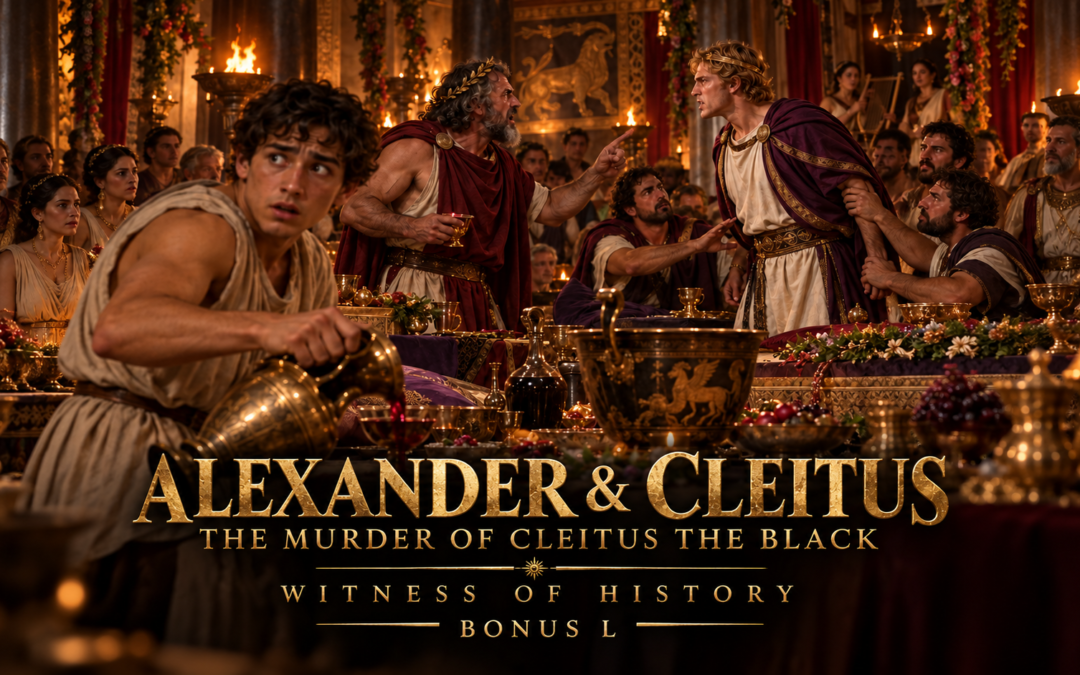
What happens when the one man who can speak to Alexander the Great as an equal finally says too much? Through the eyes of a young Macedonian cupbearer, witness the fatal banquet at Maracanda where wine, old loyalties, Philip II’s legacy, and years of resentment erupt between Alexander and Cleitus the Black, the man who once saved his life. This immersive historical podcast explores Macedonian court culture, Alexander’s changing kingship, and one irreversible moment of rage.
Narrator: Leonnatos, young Macedonian cupbearer serving at Alexander’s court
Setting: Maracanda, Sogdiana, 328 BCE
1. Sources
a. Ancient Sources
- Arrian, Anabasis of Alexander, Book IV, Chapters 8 to 9
- One of the principal accounts of the fatal quarrel between Alexander and Cleitus.
- The banquet, heavy drinking, escalating argument and killing.
- Cleitus' criticism of Alexander and defense of Philip II and the Macedonians.
- Alexander's immediate remorse after killing him.
- Plutarch, Life of Alexander, Chapters 50 to 52
- The fullest account of the emotional and personal dimensions of the quarrel.
- The songs mocking Macedonian commanders who had recently suffered defeats.
- Cleitus' anger at Macedonians being ridiculed.
- Cleitus reminding Alexander of Philip's achievements, Macedonian blood and his own rescue of Alexander at the Granicus.
- His mockery of Alexander's claim to divine descent from Ammon.
- Alexander's intense remorse after the killing.
- Quintus Curtius Rufus, History of Alexander, Book VIII, Chapter 1
- A detailed alternative version of the banquet and argument.
- The tensions between Alexander's increasingly elevated kingship and older Macedonian attitudes.
- The escalation of the dispute, attempts to restrain the two men and Cleitus' death.
- Alexander's subsequent horror and grief.
b. Modern Sources
- Adrian Goldsworthy, Philip and Alexander: Kings and Conquerors
- Used for Cleitus' military career, the Macedonian court, the Granicus and the wider development of Alexander's kingship.
- Peter Green, Alexander of Macedon, 356 to 323 B.C.
- Used for the political atmosphere surrounding the murder of Cleitus and the tensions between Alexander and his older Macedonian officers.
- Elizabeth D. Carney, King and Court in Ancient Macedonia
- Used for Macedonian court culture, the relationship between king and Companions, elite drinking culture and the unusually frank political environment of the Macedonian court.
- A. B. Bosworth, Conquest and Empire: The Reign of Alexander the Great
- Used for the changing nature of Alexander's monarchy, his relationship with the Macedonian elite and the political context of the Central Asian campaigns.
2. Author's Notes
a. Historical
- Cleitus the Black was a senior Macedonian officer with deep connections to Alexander's royal household. His sister Lanike had been Alexander's nurse.
- At the Granicus in 334 BCE, Cleitus famously intervened when Alexander was in mortal danger and killed a Persian attacker before he could strike the king.
- After the fall of Philotas, Alexander divided command of the Companion cavalry, with Cleitus becoming one of its senior commanders.
- The fatal banquet took place at Maracanda in 328 BCE, during Alexander's campaigns in Sogdiana.
- Heavy drinking was an important part of the ancient tradition. The quarrel between Alexander and Cleitus became increasingly personal as the banquet continued.
- According to Plutarch, performers sang songs mocking Macedonian commanders who had recently suffered defeats. Older Macedonians were offended, while Alexander and others encouraged the performance.
- Cleitus defended the achievements of Philip II and the Macedonian army, arguing that Alexander's victories had been purchased with Macedonian blood.
- Cleitus also reminded Alexander that he had saved his life at the Granicus and attacked his claims of divine parentage.
- The surviving accounts differ over the exact final sequence, but agree that Alexander killed Cleitus during a sudden explosion of rage rather than through a planned political execution.
- Alexander's profound remorse afterward is strongly represented across the ancient tradition, although individual details about his behavior differ between sources.
b. Reconstructed
- Leonnatos the cupbearer is fictional. He should not be confused with the historical Leonnatus, one of Alexander's prominent Macedonian officers.
- His presence throughout the banquet, his work pouring wine and his ability to observe the entire quarrel are reconstructed for the episode.
- The exact progression from laughter to discomfort to complete silence is fictional, although it reflects the escalating hostility described by the ancient authors.
- The dialogue is reconstructed. The episode draws on accusations preserved in the sources, particularly those concerning Philip, Macedonian sacrifices, Alexander's divine claims and Cleitus saving Alexander at the Granicus, but does not reproduce a verbatim historical conversation.
- The claim that Cleitus objected specifically to Persians taking positions once held by Macedonians reflects genuine wider tensions in Alexander's court, but is not securely preserved as one of Cleitus' statements during this particular banquet.
- Likewise, the idea of Alexander's old companions becoming subjects rather than friends is a thematic interpretation of the changing Macedonian court.
- The songs presenting Alexander as greater than Heracles are reconstructed. The surviving account more securely describes songs ridiculing recently defeated Macedonian commanders.
- The exact movements of servants, musicians and officers during the quarrel are fictional. Ancient accounts preserve attempts to restrain Alexander and remove Cleitus, but not the precise scene portrayed here.
- The murder itself is deliberately simplified because Arrian, Plutarch and Curtius differ in the details of how Cleitus returned to the confrontation, what weapon Alexander seized and precisely how the fatal blow occurred.
- Alexander repeatedly calling Cleitus' name, appearing afraid and momentarily seeming to become simply a grieving man are fictional emotional details built around his historically attested remorse.
- The closing description of Cleitus as Alexander's "oldest friend" is also stronger than the evidence allows. It is safer to describe him as an older Macedonian companion with deep personal ties to Alexander and, most importantly, the man who had once saved his life.