
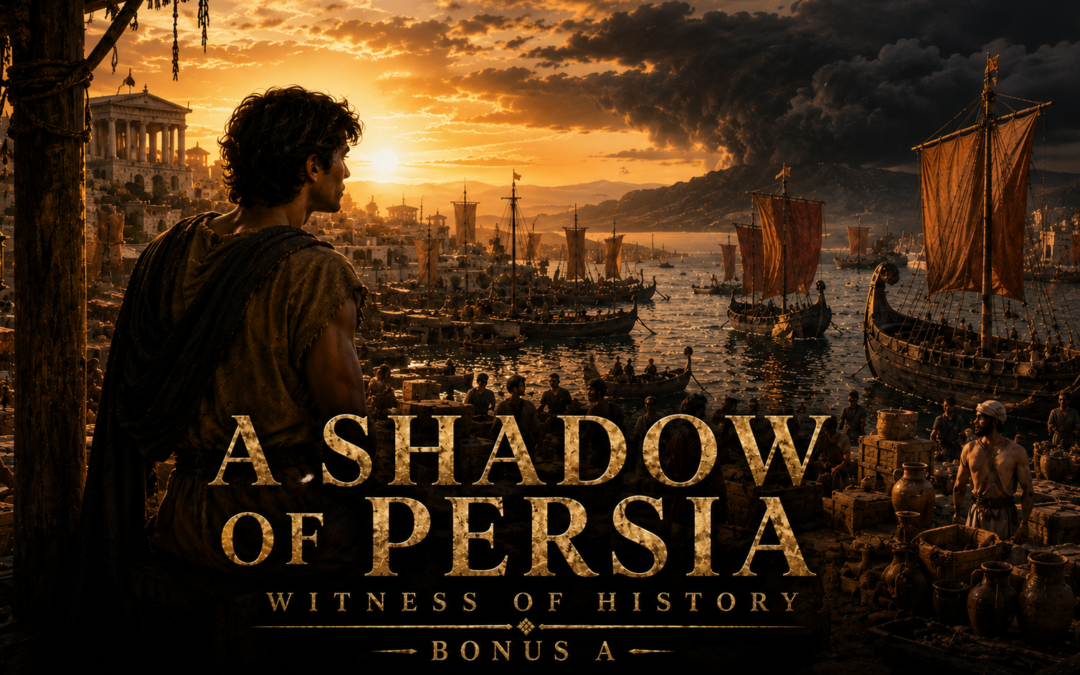
Abdamon of Sidon, a phoenician trader narrates how people under Persian control saw the successor of Philip II. Alexander the Great was a 20 year old king who succeeded his father Philip II who was planning to invade Persia. Through the eyes of Abdamon and the other traders in Sidon. What they thought of him and what were they hoping for.
Narrator: Abdamon of Sidon
Setting: Eastern Mediterranean, 340–336 BCE
1. Historical Sources
a. Ancient Sources
- Herodotus, Histories (background on the Persian Empire and Phoenician world)
- Xenophon, Cyropaedia (Persian imperial traditions and ideology)
- Diodorus Siculus, Library of History
- Arrian, Anabasis of Alexander (background on Philip's plans and Alexander's succession)
- Justin, Epitome of Pompeius Trogus
b. Modern Sources
- Pierre Briant, From Cyrus to Alexander: A History of the Persian Empire
- Adrian Goldsworthy, Philip and Alexander
- Peter Green, Alexander of Macedon, 356–323 BC
- Philip Freeman, Alexander the Great
- Robin Lane Fox, Alexander the Great
2. Author's Notes
a. Historical
- Sidon was one of the principal Phoenician cities of the eastern Mediterranean.
- During this period Sidon was part of the Achaemenid Persian Empire.
- Persian authority extended from the Mediterranean to Central Asia and was widely regarded as the dominant power of the known world.
- Phoenician cities played an important role in Persian trade and naval power.
- Philip II transformed Macedonia into the leading military power in Greece.
- Philip established the League of Corinth and prepared a campaign against the Persian Empire.
- Many contemporaries viewed the idea of a Macedonian invasion of Persia as unrealistic or unlikely to succeed.
- Philip was assassinated in 336 BCE.
- Alexander inherited the Macedonian throne at approximately twenty years of age.
- Many observers outside Greece initially underestimated Alexander because of his youth.
b. Reconstructed
- Abdamon of Sidon.
- His family and merchant background.
- Conversations in the harbor and taverns.
- The discussion with his father.
- Specific reactions to news from Greece.
- The atmosphere of confidence surrounding Persian rule.
- The belief that Philip's death had ended any threat to Persia.
- The tavern scene in which Alexander's age is discussed.
- Personal reflections and observations not preserved in historical sources.