
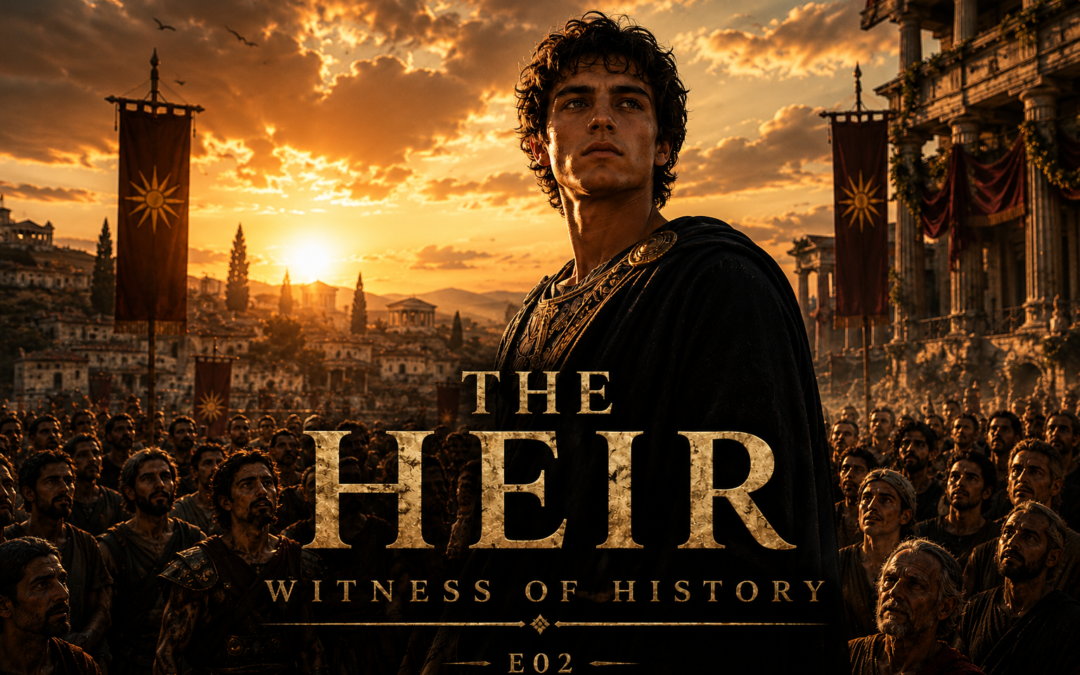
In this episode we focus on Alexander the great in important weddings that he attended as a Prince. After Alexander tames Bucephalus in the first episode, in this episode we focus on his father's wedding from Cleopatra the Macedonian and how Atalus gives a toast that makes Alexander angry and even faces his father who was drunk. Then the second wedding when Philip was assassinated. We encounter both events through the eyes of a servent at Aegae who was hoping to be employed at the palace if the events went well, but both events were a disaster.
Narrator: Palace Servant at Aegae
Setting: Aegae, 337–336 BCE
1. Sources
a. Ancient Sources
- Plutarch, Life of Alexander
- Diodorus Siculus, Library of History
- Justin, Epitome of Pompeius Trogus
- Aristotle (indirect context on the Macedonian court)
- Arrian, Anabasis of Alexander (background on Philip and Alexander)
b. Modern Sources
- Adrian Goldsworthy, Philip and Alexander
- Peter Green, Alexander of Macedon, 356–323 BC
- Philip Freeman, Alexander the Great
- Robin Lane Fox, Alexander the Great
- Ian Worthington, Philip II of Macedonia
- James Romm (ed.), The Landmark Arrian
2. Author's Note
a. Historical
- Philip II married Cleopatra Eurydice, a young Macedonian noblewoman, in 337 BCE.
- The marriage created concerns about Alexander's position as heir.
- During the wedding banquet, Attalus publicly prayed for a legitimate heir to the Macedonian throne.
- Alexander interpreted the remark as an insult directed at him and his mother Olympias.
- Alexander threw a drinking cup at Attalus and a public confrontation followed.
- Philip attempted to intervene but, according to ancient sources, stumbled while drawing his sword.
- Alexander reportedly mocked Philip's fall, questioning how a man who could not cross a room planned to cross from Europe into Asia.
- Following the quarrel, Alexander and Olympias temporarily left Macedonia.
- Reconciliation later occurred and Alexander returned to court.
- In 336 BCE Philip attended the wedding celebrations of his daughter Cleopatra and Alexander of Epirus at Aegae.
- Philip deliberately entered the theatre with minimal personal protection as a display of confidence and royal authority.
- Pausanias, one of Philip's bodyguards, assassinated the king during the procession.
- Pausanias was killed while attempting to escape.
- Philip's death immediately triggered a succession crisis.
- Alexander moved quickly to secure the throne and was proclaimed king shortly afterward.
b. Reconstructed
- The palace servant narrator.
- The recurring motif of the sharpening blade.
- The narrator's ambitions for advancement within the palace.
- Conversations, observations, and reactions among servants and guests.
- Detailed descriptions of the celebrations and preparations.
- The narrator's interpretation of Philip and Alexander's personalities.
- Emotional reactions during the assassination.
- The spread of Alexander's name through the city after Philip's death.
- Internal thoughts and reflections not preserved by ancient sources.