
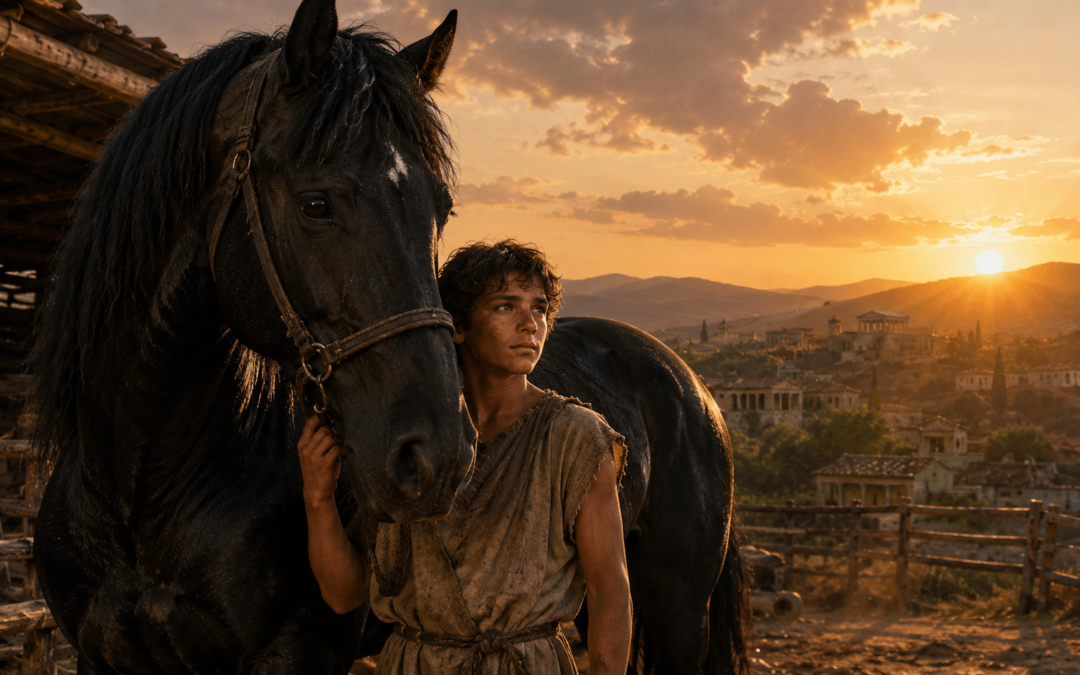
In this immersive podcast episode, we live through the eyes of Nikanor, a stable boy, inside Plutarch's history of Alexander the great first meeting with Bucephalus and how it was afraid of its shadow that no one was able to ride it. Until Alexander shows up and calms it down. This immersive storytelling audio drama makes us live during the situation and experience it as if we are there.
Narrator: Nikanor, Stable Apprentice
Setting: Pella, Macedonia, c. 344 BCE
Sources
- Plutarch, Life of Alexander (primary source)
Historical Data
- A Thessalian horse trader brought an exceptionally expensive horse to Philip's court.
- The horse was considered uncontrollable and impossible to ride.
- Philip initially rejected the purchase because nobody could manage the animal.
- Alexander observed that the horse was frightened by its own shadow.
- Alexander turned the horse toward the sun and successfully calmed it.
- Alexander mounted and rode the horse successfully.
- Philip was deeply impressed.
- Ancient sources preserve Philip's famous remark that Macedonia was too small for Alexander and that he should seek a greater kingdom.
- The horse later became known as Bucephalus and accompanied Alexander throughout much of his campaign.
Reconstructed Data
- Nikanor, the stable apprentice narrator.
- The trader's conversations with Nikanor.
- Stable life in Pella.
- The timeline of failed riders before Philip's inspection.
- Nikanor's growing attachment to the horse.
- Crowd reactions, conversations, and observations.
- The narrator's interpretation of Alexander's character.
- The detailed sequence of events leading up to the demonstration.
- The emotional perspective of witnesses present that day.
Historical Context
- The event likely occurred while Alexander was still a teenager, several years before he became king.
- At the time, Philip had already transformed Macedonia into the dominant power in Greece.
- Alexander was known as the king's heir, but had not yet proven himself in war.
- The story became one of the most famous anecdotes of Alexander's youth because later generations viewed it as an early glimpse of the qualities that would make him a conqueror.