
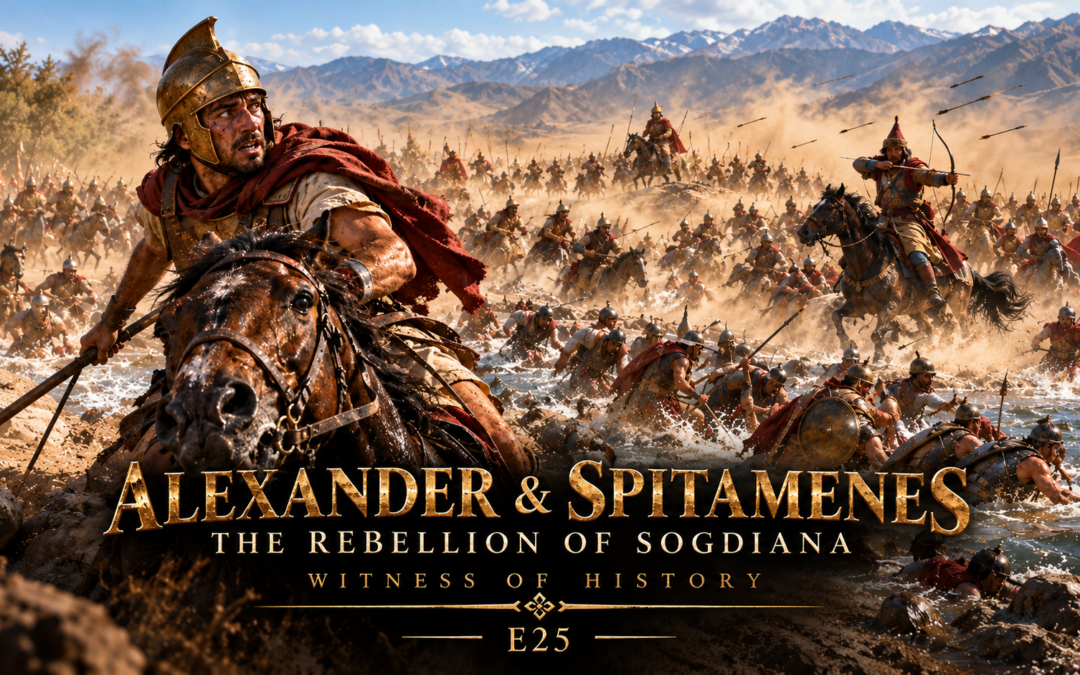
What happens when Alexander the Great faces an enemy who refuses to fight the kind of war he knows how to win? Through the eyes of a Thessalian cavalryman who chose to remain in Asia, witness Spitamenes turn Sogdiana into a nightmare of ambushes, mounted archers, broken pursuits, and one of the worst disasters suffered by Alexander’s army. This immersive historical podcast explores guerrilla warfare, survivor’s guilt, and the brutal campaign that forced Alexander to change how he fought.
Narrator: Philinos, Thessalian cavalryman who remained in Alexander’s service as a mercenary after the Thessalian cavalry was discharged
Setting: Sogdiana and Bactria, 329-328 BCE
1. Sources
a. Ancient Sources
- Arrian, Anabasis of Alexander, Book IV
- The principal account of the revolt of Spitamenes.
- The expedition sent to relieve Maracanda.
- The composition of the Macedonian force under Pharnuches and the Macedonian commanders.
- Spitamenes' use of mobile Scythian cavalry and mounted archery.
- The disaster at the Polytimetus River.
- Aristobulus' alternative account in which a small number of Macedonian cavalry and infantry survived.
- Alexander's rapid march toward Maracanda after learning of the defeat.
- The later campaigns under Coenus and the eventual collapse of Spitamenes' resistance.
- Quintus Curtius Rufus, History of Alexander, Books VII and VIII
- The revolt in Sogdiana and Bactria.
- The scale of the Macedonian defeat, including the tradition of roughly 2,000 infantry and 300 cavalry killed.
- Alexander's subsequent campaign against the rebellious regions.
- Alternative traditions concerning the death of Spitamenes.
- Diodorus Siculus, Library of History, Book XVII
- The eastern campaigns and the continuing resistance to Alexander.
- The wider context of the Thessalian cavalry's discharge and rewards.
- Traditions concerning the final stages of Spitamenes' resistance.
- Plutarch, Life of Alexander
- Used for the broader eastern campaign and traditions concerning Alexander's treatment of his soldiers and the continuing conquest.
- Strabo, Geography, Book XI
- Used for the geography and peoples of Sogdiana, Bactria and the Central Asian frontier.
b. Modern Sources
- Adrian Goldsworthy, Philip and Alexander: Kings and Conquerors
- Used for the military context of the Sogdian campaigns, Macedonian cavalry and the physical demands placed on Alexander's forces.
- Peter Green, Alexander of Macedon, 356-323 B.C.
- Used for the chronology of the revolt, Alexander's response and the increasingly destructive nature of the campaign in Sogdiana.
- Philip Freeman, Alexander the Great
- Used for the wider narrative of Spitamenes' resistance and Alexander's changing methods of warfare in Central Asia.
- Rolf Strootman, "Alexander's Thessalian Cavalry"
- Used particularly for the Thessalian cavalry, their discharge at Ecbatana and the possibility that some cavalrymen remained in Alexander's service as mercenaries.
- F. L. Holt, Alexander the Great and Bactria
- Used for the political, geographical and military setting of Alexander's campaigns in Bactria and Sogdiana.
2. Author's Notes
a. Historical
- At Ecbatana in 330 BCE, Alexander discharged the Thessalian cavalry and other Greek allied contingents. Men who wished to continue serving could remain as mercenaries, and later tradition records very generous financial incentives for doing so.
- Spitamenes had previously helped bring down Bessus, but soon became one of Alexander's most dangerous opponents in Sogdiana.
- When Spitamenes threatened Maracanda, Alexander sent a relief force consisting of 60 Companion cavalry, 800 mercenary cavalry and 1,500 mercenary infantry. The Lycian Pharnuches, valued for his knowledge of local peoples and languages, was placed over the expedition.
- Spitamenes used highly mobile Sacae or Scythian cavalry, including mounted archers, to harass the Macedonians while avoiding the kind of close combat in which Alexander's forces were strongest.
- The relief force suffered a catastrophic defeat near the Polytimetus River. Arrian's main account presents the destruction as nearly complete, but he also preserves Aristobulus' version in which approximately 40 cavalrymen and 300 infantrymen escaped.
- Curtius gives losses of roughly 2,000 infantry and 300 cavalry, making the battle one of the worst disasters suffered by Alexander's forces during the Asian campaign.
- Alexander responded with extraordinary speed, covering approximately 1,500 stadia in three days with a selected force before reaching the region around Maracanda.
- Alexander later changed his approach. Rather than relying only on pursuit, his commanders operated in multiple strong columns, occupied settlements, secured roads and restricted the areas in which Spitamenes could move and find support.
- Spitamenes continued resistance for some time, including further raids and attacks around Zariaspa, before suffering defeat against forces commanded by Coenus.
- The ancient sources preserve different versions of Spitamenes' death. One tradition has his remaining nomadic allies killing him, while another famously claims that his wife killed him in his sleep and brought his head to Alexander.
b. Reconstructed
- Philinos is fictional. His background, family, ambitions and personal decision to remain in Asia are created for the episode.
- His participation at Issus and Gaugamela is fictional but plausible for a Thessalian cavalryman who had served with Alexander from the beginning of the Asian expedition.
- Philinos' decision to stay because the promised three talents might allow him to buy land and horses is fictional, although the generous reenlistment incentive itself comes from ancient tradition.
- His presence in the expedition destroyed near Maracanda is reconstructed using Aristobulus' version, which allows a small number of cavalrymen to survive.
- The details of Philinos' escape, the dust, falling horses, confused orders and his survivor's guilt are fictional.
- His presence when Alexander reaches the battlefield and his participation in burying the dead are reconstructed around the historical account of Alexander reaching the area after the disaster.
- Philinos later serving with Coenus and witnessing Spitamenes' final military defeat is fictional.
- The episode simplifies a complicated sequence of operations in Sogdiana into a clearer narrative of Alexander gradually changing from pursuing Spitamenes to restricting his ability to move.
- Philinos hearing both versions of Spitamenes' death is fictional, but the conflicting stories themselves come from the surviving ancient tradition.
- His final emotional response, expecting revenge to bring satisfaction but instead feeling emptiness, is fictional and reflects the larger theme that Spitamenes' death did not undo the losses suffered during the campaign.