
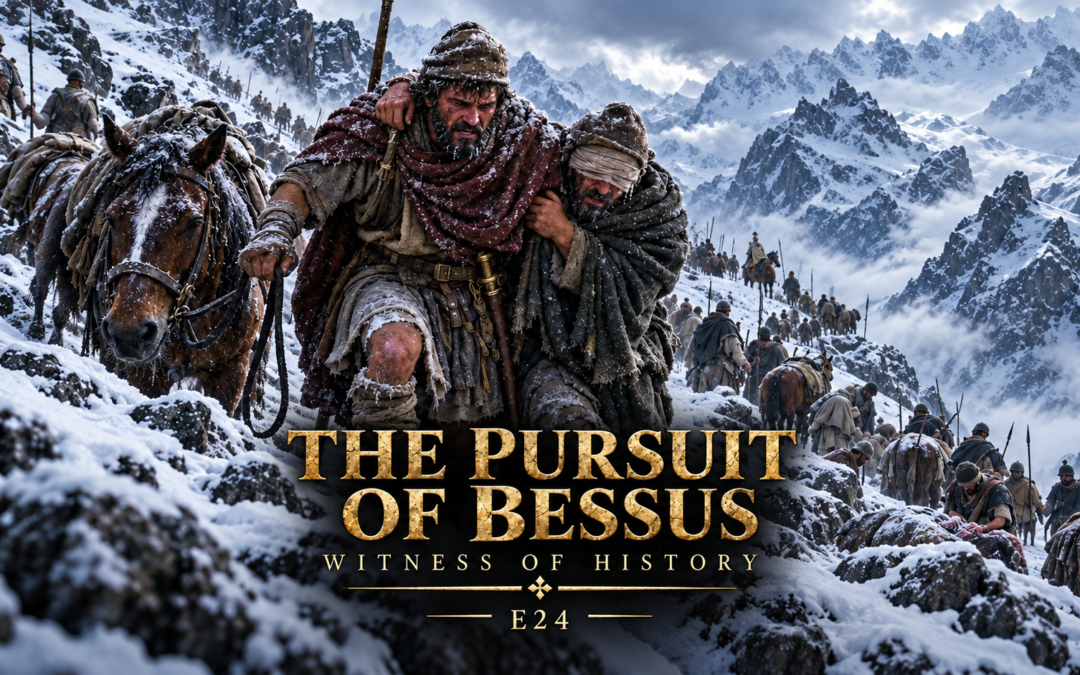
How far would Alexander the Great drive his army to capture one man? Through the eyes of a Macedonian cavalryman, follow the pursuit of Bessus across the Hindu Kush, through Bactria’s deserts, and over the Oxus River. This immersive historical podcast explores starvation, cold, exhaustion, betrayal, and Alexander’s transformation from conqueror of Persia into avenger of Darius III, only to discover that catching Bessus would not bring the eastern war to an end.
Narrator: Kleon, Macedonian cavalryman serving in Alexander’s army
Setting: Hindu Kush → Bactria → Oxus River → Sogdiana, 329 BCE
1. Sources
a. Ancient Sources
- Arrian, Anabasis of Alexander, Books III and IV
- The principal source for Alexander's pursuit of Bessus.
- Bessus assuming the royal name Artaxerxes.
- The advance through Bactria and across the Oxus.
- The dispersal of Bessus' supporters.
- The use of leather skins to cross the Oxus.
- Spitamenes and Dataphernes turning against Bessus.
- Ptolemy's expedition to secure Bessus.
- Bessus being stripped, placed in a wooden collar and presented beside the road.
- His later mutilation and transfer for punishment.
- Quintus Curtius Rufus, History of Alexander, Book VII
- The difficult march through the Hindu Kush.
- Food shortages and the slaughter of pack animals.
- Bessus' retreat from Bactria.
- Alternative details concerning his capture and punishment.
- Diodorus Siculus, Library of History, Book XVII
- Bessus' role in the betrayal of Darius.
- His attempt to continue resistance in Bactria.
- Alexander's pursuit through the eastern provinces.
- Alternative traditions surrounding Bessus' capture and eventual punishment.
- Strabo, Geography, Book XV
- Used for the geography of Bactria, Sogdiana, the Oxus region and the mountainous approaches into Central Asia.
- Plutarch, Life of Alexander
- Used as an additional tradition for Darius' death and the later punishment of Bessus.
- Plutarch preserves a different version of Bessus' final execution from some of the other surviving accounts.
b. Modern Sources
- Adrian Goldsworthy, Philip and Alexander: Kings and Conquerors
- Used for the chronology and military context of Alexander's eastern campaigns.
- Particularly useful for the increasing strain placed on the army by distance, terrain, climate and prolonged campaigning.
- Peter Green, Alexander of Macedon, 356-323 B.C.
- Used for Alexander's pursuit of Bessus, the political transformation following Darius' death and the movement into Bactria and Sogdiana.
- Philip Freeman, Alexander the Great
- Used for the narrative reconstruction of the Hindu Kush crossing, Bactria, the Oxus and the collapse of Bessus' resistance.
- F. L. Holt, Alexander the Great and Bactria
- Used for the geography, political situation and military difficulties Alexander encountered in Bactria and the surrounding eastern regions.
- A. B. Bosworth, Conquest and Empire: The Reign of Alexander the Great
- Used for Alexander's changing political position after Darius' death and the nature of his campaigns in the eastern satrapies.
- Encyclopaedia Iranica, "Bessos"
- Used for Bessus' career, his position as satrap of Bactria, his assumption of the royal title and the traditions surrounding his downfall.
2. Author's Notes
a. Historical
- After the murder of Darius III in 330 BCE, Bessus, satrap of Bactria and one of the men involved in Darius' overthrow, adopted the royal name Artaxerxes and attempted to continue resistance against Alexander.
- Alexander's advance toward Bactria was interrupted by the rebellion of Satibarzanes in Areia, after which the pursuit of Bessus resumed.
- The crossing of the Hindu Kush was historically extremely difficult, with ancient sources describing severe shortages and the slaughter of pack animals for food.
- The exact mountain route is uncertain. The Khawak Pass is a plausible modern reconstruction, but the ancient sources do not identify the pass by a modern name.
- Ancient traditions place roughly 7,000 to 8,000 Bactrian cavalrymen with Bessus before much of his support collapsed as he abandoned Bactria.
- Bessus crossed the Oxus River and destroyed the available boats. Alexander's soldiers crossed using improvised flotation devices made from leather skins.
- Bessus was eventually betrayed by members of his own faction, particularly Spitamenes and Dataphernes, who arranged to surrender him to Alexander.
- Alexander sent Ptolemy with a strong mounted force, including three hipparchies of Companion cavalry, to secure Bessus.
- Arrian describes Bessus being brought before Alexander naked and wearing a wooden collar. Alexander publicly accused him of betraying Darius, his king, kinsman and benefactor.
- Bessus was flogged after his capture. His nose and ears were mutilated later, before he was sent toward Ecbatana for final punishment. The surviving sources disagree about the precise circumstances of his eventual execution.
b. Reconstructed
- Kleon is fictional. His participation in the pursuit and his placement within the cavalry force sent with Ptolemy are reconstructed.
- Timon, his temporary blindness and Kleon's efforts to keep him moving through the mountains are fictional.
- The opening scene of Kleon eating raw horse or mule meat because there was insufficient wood to cook it is reconstructed from the historically attested food crisis and slaughter of pack animals.
- Kleon's numbness, frostbite, snow blindness and altitude symptoms are plausible reconstructions of conditions in the Hindu Kush rather than individually recorded experiences.
- Alexander personally passing Kleon and Timon while shouting for exhausted soldiers to keep moving is dramatized.
- The episode's use of the Khawak Pass is deliberately presented as a reconstruction rather than a certain identification.
- Bactra simply opening its gates is a narrative simplification. The sources indicate that Alexander brought Bactria under control with limited resistance, but do not preserve this exact surrender scene.
- Kleon's growing hatred of Bessus, his resentment over the suffering of the army and his disappointment when he finally sees the captive are fictional.
- Kleon's presence at the roadside confrontation between Alexander and Bessus is reconstructed to allow the historical event to be experienced from a soldier's perspective.
- The final exchange in which Kleon asks where the army is going and receives the answer "East" is fictional. It reflects the historical reality that capturing Bessus did not end Alexander's eastern war. The resistance of Spitamenes and the campaigns in Sogdiana were still ahead.