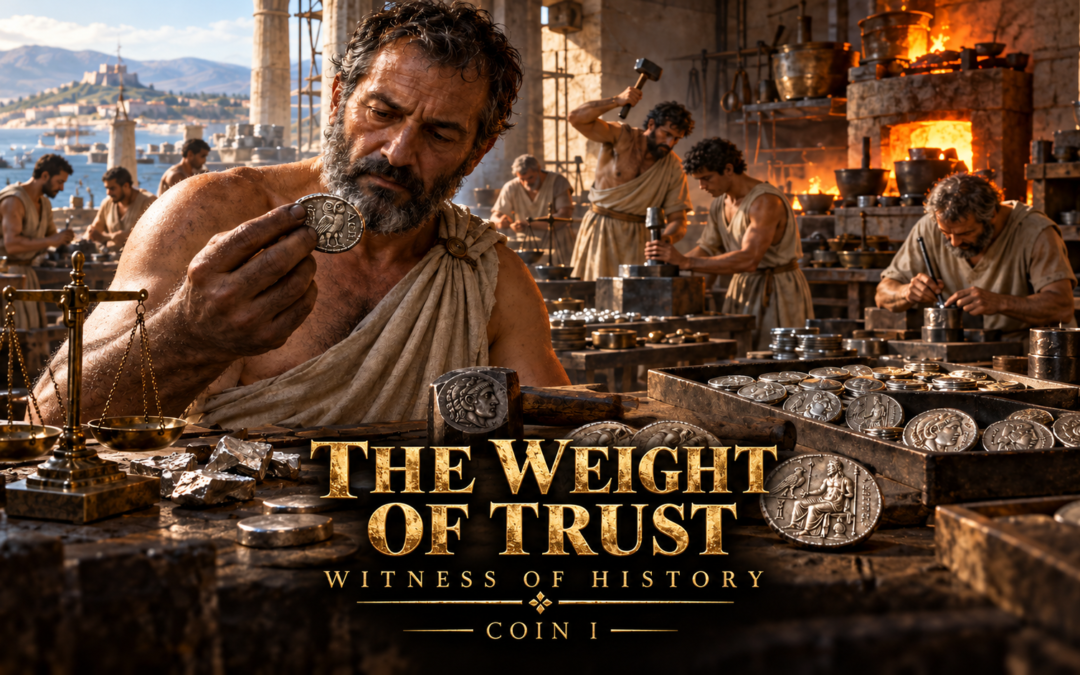
How were the coins of Philip II and Alexander the Great actually made, trusted, and used? Through the eyes of a veteran craftsman at the royal mint of Amphipolis, step inside an ancient Macedonian workshop where silver is weighed, dies are engraved, blanks are struck, and old coins begin new lives. This immersive historical podcast explores Alexander’s tetradrachms, Philip’s continuing coinage, Athenian owls, Persian treasure, and the surprisingly human story behind the money that helped finance an empire.
Narrator: Lysias, Craftsman of the Royal Mint at Amphipolis
Setting: Amphipolis, Macedonia - 327 BCE
1. Sources
a. Ancient Sources
- Surviving coins of Philip II and Alexander III
- The most important primary evidence for the episode.
- Used for the coin types, legends, weight standards, die variations and continuation of Philip's types during Alexander's reign.
- Surviving Athenian owl tetradrachms
- Used for the Athena and owl types, Attic weight standard and examples carrying ancient test cuts made to examine the silver.
- Diodorus Siculus, Library of History, Books XVI and XVII
- Philip II's acquisition of Amphipolis and the mining wealth associated with the Pangaion region.
- Alexander's capture of the enormous Achaemenid treasuries at Susa and Persepolis.
- Arrian, Anabasis of Alexander, Book III
- Alexander's occupation of the Persian royal centers and seizure of their accumulated treasure.
- Provides the wider historical setting for the enormous quantities of precious metal that became available during the conquest.
- Macedonian inscriptions from Amphipolis
- Epigraphic evidence helps illuminate monetary terminology, the continuing importance of Philip's and Alexander's coinage, and the monetary world of Amphipolis.
b. Modern Sources
- Georges Le Rider, Alexander the Great: Coinage, Finances, and Policy
- The principal modern source for the episode.
- Used for Alexander's coinage, Macedonian mint production, chronology, precious metal resources, Persian treasure and monetary policy.
- Martin Jessop Price, The Coinage in the Name of Alexander the Great and Philip Arrhidaeus
- A fundamental catalogue and study of Alexander's coinage, mint attributions, types, symbols and surviving issues.
- Georges Le Rider, Le monnayage d'argent et d'or de Philippe II frappé en Macédoine de 359 à 294
- Important for Philip II's gold and silver coinage and the continuation of Philip's types after his death.
- Adrian Goldsworthy, Philip and Alexander: Kings and Conquerors
- Used for the wider political, military and financial setting of Philip's Macedonia and Alexander's campaigns.
- A. B. Bosworth, Conquest and Empire: The Reign of Alexander the Great
- Used for the wider imperial and financial consequences of Alexander's conquest of the Achaemenid Empire.
2. Author's Notes
a. Historical
- Amphipolis became an important center of Macedonian coin production. Philip II's control of Amphipolis and the mineral wealth around Mount Pangaion greatly strengthened the monarchy's access to gold and silver.
- Philip's coinage continued after his death. Alexander's accession in 336 BCE did not cause Philip's familiar types to disappear. Old and new Macedonian coinages circulated together.
- The chronology of Alexander's earliest royal coinage remains debated. Le Rider favors a major introduction of Alexander's new silver types around 333/332 BCE, rather than immediately upon his accession.
- Alexander's famous silver tetradrachm showed Herakles in the lion skin and Zeus seated with eagle and sceptre, accompanied by Alexander's name. The Herakles image should not simply be treated as a portrait of Alexander.
- Alexander's principal gold stater type showed Athena and Nike. His silver tetradrachms followed the Attic standard at roughly 17.2 grams in theoretical weight.
- Ancient coins were produced using prepared metal blanks and engraved dies struck by hammer. Off-center strikes, weak impressions, worn dies and die cracks are natural products of this manufacturing process.
- Alexander acquired enormous quantities of Achaemenid precious metal and bullion. Turning stored wealth into usable currency helped finance soldiers, garrisons, supplies and the administration of his expanding empire.
- Alexander's money did not replace every other currency. Philip's coins, Athenian silver, local coinages and Alexander's issues could circulate alongside one another.
- Ancient Athenian owl tetradrachms sometimes preserve test cuts made to examine whether the metal beneath the surface was genuine silver.
b. Reconstructed
- Lysias is fictional. No testimony survives from a named craftsman working at the Amphipolis mint during Alexander's reign.
- Lysias's master, Myron, Nikanor, the other workers and all conversations and relationships inside the mint are fictional.
- The exact layout of the workshop, including separate areas for weighing, engraving, furnaces, striking and dispatch, is reconstructed from the practical processes involved in ancient coin production.
- The scarred Athenian owl that arrives at Lysias's workshop is fictional. Real Athenian tetradrachms circulated widely and genuine examples with ancient test cuts survive, but there is no evidence for this particular coin reaching Amphipolis in 327 BCE.
- The imagined history of the owl is deliberately left unknown. Its test cut can show that someone once questioned its silver, but it cannot reveal who tested it or where the coin travelled.
- Lysias deciding to save the owl from the furnace, and remembering a similar coin shown to him by his master as a boy, are entirely fictional and provide the episode's emotional frame.
- The episode is set at Amphipolis in 327 BCE, while Alexander is still alive and campaigning far to the east.