
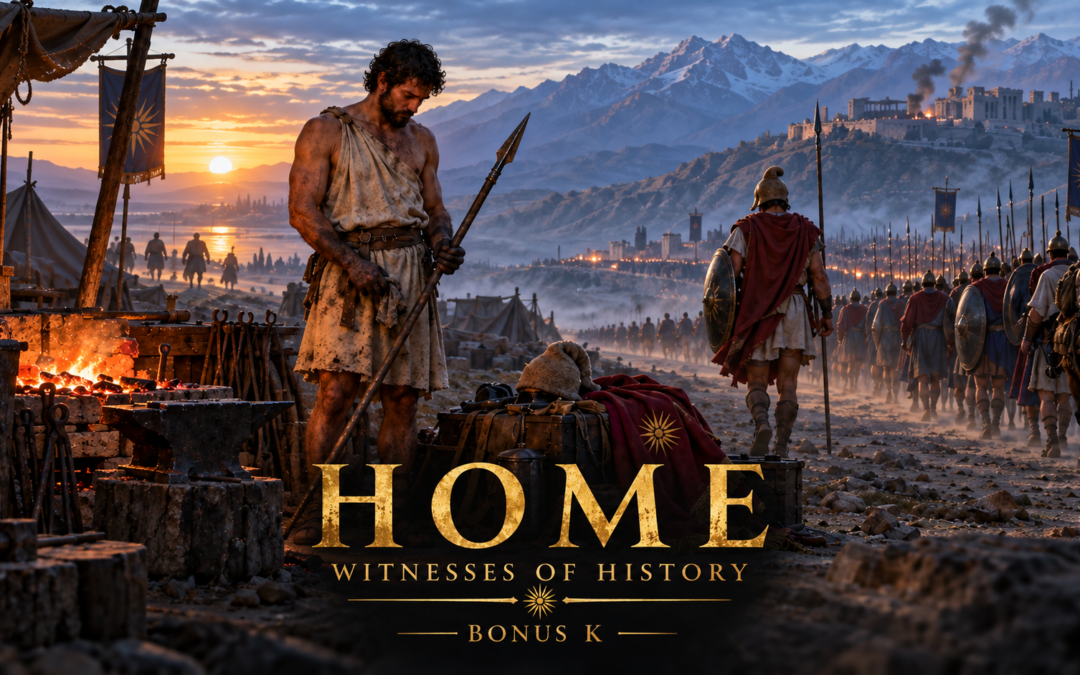
How many victories can a man trade for years of his life? Through the eyes of Menon, a blacksmith in Alexander’s army, follow the Macedonians after Persepolis as wealth, exhaustion, and years away from home begin to change what victory means.
With Darius dead and the war they thought they were fighting seemingly over, the soldiers finally prepare to return west, only to learn that Alexander intends to continue east in pursuit of Bessus.
This immersive historical fiction podcast explores the growing homesickness of Alexander’s veterans, the dismissal of the Greek allied troops, the endless logic of continuing conquest, and the first unsettling realization that for Alexander, every victory did not bring the army closer to home. It simply revealed somewhere else to go.
Narrator: Menon, Macedonian blacksmith attached to Alexander’s army
Setting: Persepolis to Ecbatana, then east through Media during the final pursuit of Darius, 330 BCE
Sources
Ancient Sources
- Arrian, Anabasis of Alexander, Book 3, especially 3.19 to 3.25
- Alexander's pursuit of Darius after Persepolis.
- The dismissal of the Thessalian cavalry and other Greek allied contingents at Ecbatana.
- Alexander paying the departing allies and allowing those who wished to remain to reenlist as mercenaries.
- The increasingly rapid pursuit after Alexander learned that Bessus and other Persian nobles had seized Darius.
- The exhaustion of Alexander's men and horses during the final chase.
- Darius being abandoned and mortally wounded by his captors.
- Alexander ordering a royal burial for Darius.
- Bessus subsequently emerging as the principal opponent in the eastern provinces.
- Diodorus Siculus, Library of History, 17.73 to 17.74
- Darius' flight, capture and death.
- The tradition that Alexander now presented himself as Darius' avenger against Bessus.
- Bessus' withdrawal to Bactria and assumption of the royal title.
- Most importantly for this episode, Diodorus explicitly states that the Macedonians regarded Darius' death as the end of the campaign and were impatient to return home.
- Alexander called an assembly and persuaded them to continue the remaining war.
- Diodorus also records the dismissal and rewards of the Greek allied troops and the substantial bonus offered to men who remained in service.
- Quintus Curtius Rufus, History of Alexander, Book 6, especially 6.2 to 6.4
- The growing reluctance of Alexander's soldiers to continue campaigning after the destruction of Persian royal power.
- Alexander's attempt to persuade the army that the conquest remained unfinished.
- Useful for the atmosphere of exhaustion, homesickness and the changing justification for continuing east.
- Justin, Epitome of Pompeius Trogus, 12.3
- Preserves another tradition of Alexander addressing soldiers who believed the Persian war had effectively been completed.
- Useful alongside Diodorus and Curtius for the army's reluctance to continue and Alexander's arguments for further campaigning.
- Plutarch, Life of Alexander, 43
- Darius' death and Alexander's treatment of his body.
- The tradition presenting Alexander as determined to punish those responsible for the Persian king's murder.
- Helps establish the remarkable change in political language whereby Alexander could move from fighting Darius to claiming to avenge him.
Modern Sources
- Adrian Goldsworthy, Philip and Alexander
- Particularly useful for the transition following Darius' death.
- Goldsworthy emphasizes how natural it was for the Macedonians to believe the expedition was finished: Persepolis had fallen, Darius was dead, the Greek allies were already returning west, and the soldiers were exhausted, wealthy from plunder and farther from home than ever before.
- Also used for the extraordinary speed and physical exhaustion of the final pursuit of Darius.
- Peter Green, Alexander of Macedon, 356 to 323 B.C.
- Used for the campaign chronology from Persepolis through Ecbatana, the dismissal of the Greek allies, the renewed pursuit of Darius, Darius' death and Bessus' assumption of the royal title.
- Philip Freeman, Alexander the Great
- Used especially for the soldiers' longing for home and Alexander's need to persuade them to continue east.
- Freeman develops the ancient tradition of the army assembly and Alexander presenting Bessus as a threat that had to be dealt with before the campaign could truly end.
- Pierre Briant, From Cyrus to Alexander: A History of the Persian Empire
- Used for the Persian perspective and for caution when interpreting the literary traditions surrounding Darius' final days.
- Briant stresses that later Greek and Roman accounts often reshape Darius' death and Alexander's role as his avenger through Macedonian political and literary traditions.
Author's Notes
Historical
- The basic historical situation is firmly attested. After Persepolis, Alexander continued into Media in pursuit of Darius. Darius was eventually seized by Bessus and other Persian nobles and mortally wounded as Alexander's pursuing force approached. Alexander then continued campaigning against Bessus and the eastern resistance.
- Homesickness is not invented for the episode. Diodorus specifically says that after Darius' death the Macedonians considered the campaign finished and were eager to return home. Alexander assembled the troops and persuaded them to continue.
- The departure of the Greek allied contingents is historical, but the ancient sources differ slightly over its placement. Arrian places their dismissal at Ecbatana while Darius was still alive. Diodorus connects it with the period after Darius' death. This episode follows Arrian's chronology, with the allies departing before news of Darius' death reaches the narrator.
- The army's wealth is historically grounded. By this point Alexander's forces had seized enormous quantities of treasure at Babylon, Susa and Persepolis. Modern reconstructions therefore support the episode's contrast between soldiers who had become materially wealthy and soldiers who increasingly wanted to enjoy that wealth at home.
- Bessus represented a genuine continuation of resistance. He had been satrap of Bactria, participated in the seizure of Darius and later assumed the royal title. His control of forces and territory in the northeast gave Alexander a concrete military and political justification for continuing the campaign.
Reconstructed
- Menon the blacksmith is fictional. His workshop, wife, leaking roof, fig tree and personal memories are created for the episode.
- The repeatedly repaired spear is fictional. It serves as the episode's symbol for soldiers who expected each campaign to be the last but repeatedly found themselves repairing their equipment for another march.
- The conversations at the forge, letters from home, dead father, children growing up and soldiers discussing farms are reconstructed personal experiences. They are intended to represent the documented homesickness and prolonged separation experienced by Alexander's army.
- Menon packing his tools after Darius' death and believing that the army is finally preparing for Macedonia is reconstructed. The wider expectation that the war should now be finished is historically attested.
- Alexander's speech is summarized through Menon's memory rather than presented as a verbatim historical speech. Ancient authors preserve versions of Alexander persuading his reluctant soldiers to continue, but their exact wording is literary reconstruction.
- The final exchange about whether the repaired spear will make it home is fictional. It condenses the central historical tension of the episode: the men increasingly measured Alexander's conquests not by how much territory remained ahead, but by how many years of their lives remained behind them.