
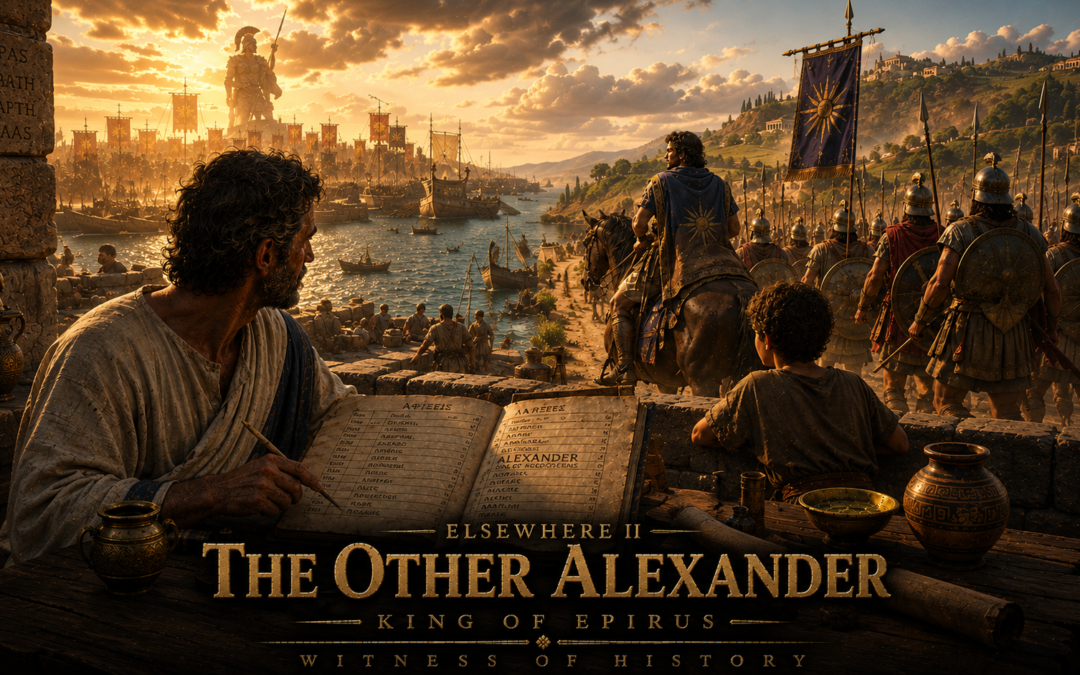
What if Alexander the Great was not the only King Alexander changing the world? While one Alexander crossed into Asia to fight Persia, his uncle, Alexander of Epirus, crossed another sea to fight for the Greek city of Taras in southern Italy. Through the eyes of a harbor clerk hearing news from both east and west, this immersive historical podcast follows two kings with the same name, two campaigns unfolding at the same time, and the moment history chose which Alexander it would remember.
Narrator: Damon, Harbor Customs Clerk of Taras
Setting: Taras (Magna Graecia), 334 - 331 BCE
Historical Sources
A. Ancient Sources
- Livy, Ab Urbe Condita, Book VIII (Chapters 24-30): Primary narrative for Alexander of Epirus' campaign in southern Italy, including his invitation by Taras, military successes, treaty with Rome, prophecy concerning Pandosia and the river Acheron, and his death.
- Diodorus Siculus, Bibliotheca Historica, Book XVII: Provides chronology and political context for the reign of Alexander the Great and the wider Greek world during the same period.
- Justin, Epitome of Pompeius Trogus, Books IX & XII: Background on the Molossian royal family, Alexander of Epirus, Olympias, and the Argead dynasty.
- Strabo, Geography, Book VI: Describes Taras, Magna Graecia, and the peoples of southern Italy.
- Plutarch, Life of Alexander & Life of Pyrrhus: Additional context on the royal family of Epirus and the legacy of the Molossian dynasty.
Author's Notes
A. Historical
- Taras (modern Taranto) was the most powerful Greek city in Magna Graecia and the only major colony founded by Sparta.
- Alexander of Epirus, brother of Olympias and uncle of Alexander the Great, accepted Taras' invitation to campaign against the tribes of southern Italy in 334 BCE.
- Ancient sources indicate that Alexander sought not only military victories but also to strengthen and expand the Molossian kingdom, helping unite the peoples later known collectively as the Epirotes.
- During the same years that Alexander the Great campaigned against Persia, Alexander of Epirus fought successfully in southern Italy before being killed near Pandosia in 331 BCE.
- News from Alexander the Great's eastern campaign would have reached Taras by merchant ships over many months, while news of Alexander of Epirus' death would have travelled much more quickly overland from southern Italy.
- The treaty between Alexander of Epirus and Rome is preserved by Livy and illustrates that Rome was already becoming a regional power, though still far from dominating the Mediterranean.
B. Reconstructed
- Damon, his son Lykos, and all conversations between them are fictional, created to represent the experience of ordinary Greeks living in Taras.
- The profession of a harbor customs clerk and his responsibility for recording ships, passengers, cargoes, and official arrivals are historically plausible, though Damon himself is fictional.
- Alexander of Epirus greeting harbor workers, Damon personally recording his arrival, and the recurring question "Which Alexander?" are literary devices created to contrast the parallel careers of the two Alexanders.
- The gradual change in how rumors spread through the harbor, and Damon's realization that one Alexander became a legend while the other remained the beloved protector of Taras, are narrative reconstructions based on the known chronology of events.
- Damon's harbor ledger and its final entry for "Alexander, son of Neoptolemus" are fictional, serving as a symbolic reminder that history is preserved not only in monuments and empires, but also in the memories and records of ordinary people.