
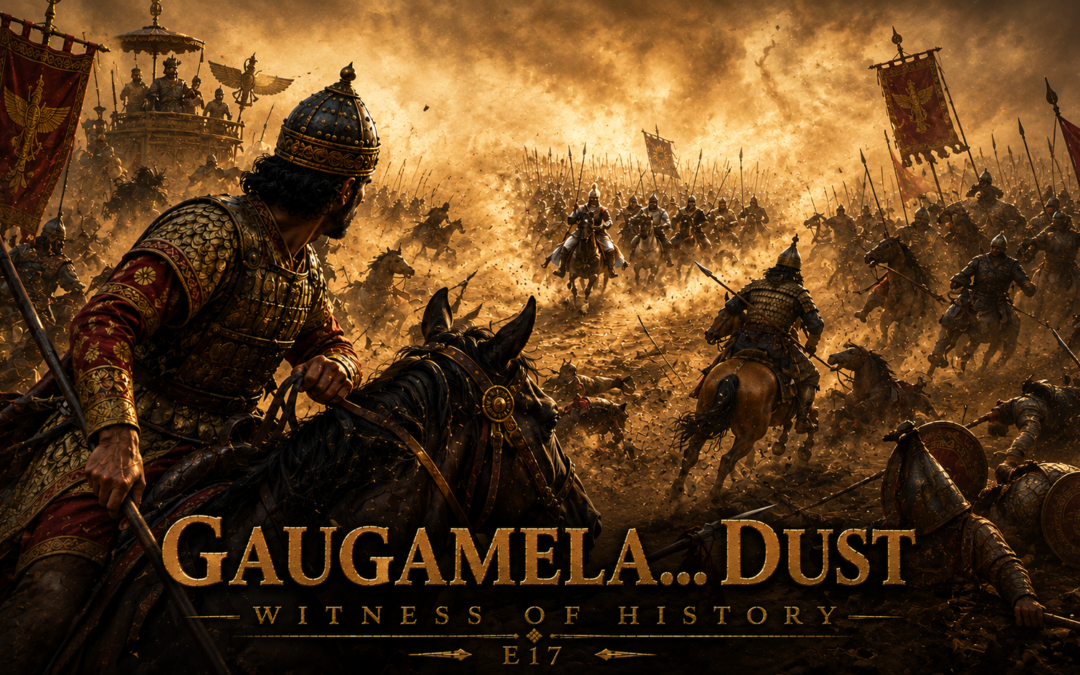
What does a battle look like when you cannot see the battle? Through the eyes of Arbupales, a veteran Persian cavalryman serving among the Great King’s elite, experience Gaugamela from inside the dust, noise, contradictory orders, and confusion of the Persian line. Darius has chosen the ground, gathered an empire, and prepared the plain for his cavalry and chariots.
Across from them, Alexander’s army looks almost disappointingly small. Then the fighting begins. Reports contradict one another. Veterans start running. A gap appears where no gap should exist. And through the dust comes a wedge of Macedonian cavalry driving toward the center of the Persian army. This immersive historical podcast tells the Battle of Gaugamela not from above, where tactics make sense on a map, but from the ground, where almost nothing does. For Arbupales, the chaos briefly clears just long enough for him to see the man behind years of rumors riding directly toward Darius, and to understand why men followed Alexander.
Narrator: Arbupales, Persian King's Kinsmen.
Setting: Gaugamela, 331 BCE
Historical Sources
Ancient Sources
- Arrian, Anabasis of Alexander (Book III)
- Diodorus Siculus, Library of History (Book XVII)
- Quintus Curtius Rufus, History of Alexander (Books IV–V)
- Plutarch, Life of Alexander
- Babylonian Astronomical Diaries
Modern Sources
- Pierre Briant, From Cyrus to Alexander: A History of the Persian Empire
- Adrian Goldsworthy, Philip and Alexander
- Robin Lane Fox, Alexander the Great
- Peter Green, Alexander of Macedon, 356–323 B.C.
- Philip Freeman, Alexander the Great
Author's Notes
Historical
- The battlefield at Gaugamela was deliberately prepared by Darius III. The ground was leveled to maximize the effectiveness of the Persian cavalry and scythed chariots before the battle.
- Darius III assembled one of the largest multinational armies of the Achaemenid Empire, including cavalry from many eastern satrapies and elite troops surrounding the Great King.
- The narrator serves among the King's Kinsmen, an elite group of Persian nobles who rode with and protected the Great King. This replaces the earlier "Immortal cavalry," as the famous Immortals were an elite infantry corps rather than cavalry.
- Ancient accounts consistently describe the battle as extraordinarily chaotic. Dust, the immense size of the armies, and the difficulty of communication meant that many soldiers understood only a small part of what was happening around them.
- Alexander's decisive attack exploited a temporary opening that developed in the Persian line as Darius attempted to match Alexander's oblique movement. Alexander then led the Companion Cavalry directly toward the Great King, one of the defining moments of the battle.
- Darius III remained near the center of the Persian army, surrounded by his royal guard and elite troops, making Alexander's charge toward him both a tactical and psychological turning point.
Reconstructed
- Arbupales is a fictional Persian cavalryman, although his name is historically attested in the late Achaemenid period.
- The conversations with the young cavalryman, the observations of veterans running, and the narrator's personal reflections are fictional reconstructions intended to represent the experience of an experienced Persian noble cavalryman.
- The individual messengers, contradictory battlefield reports, and Arbupales' gradual realization of Alexander's breakthrough are literary reconstructions based on the known confusion of large ancient battles rather than recorded eyewitness testimony.
- The narrator's first sight of Alexander, his emotional response, and the closing reflection that "every story seemed too small" are fictional but are intended to capture how a Persian veteran might have experienced Alexander's famous charge through the gap toward Darius.
This episode intentionally tells the Battle of Gaugamela from ground level. Rather than explaining Alexander's tactics from a historian's perspective, it follows a veteran Persian cavalryman whose view is limited by dust, distance, and confusion, allowing the audience to experience the battle as many participants likely did: without knowing the full picture until history had already turned.