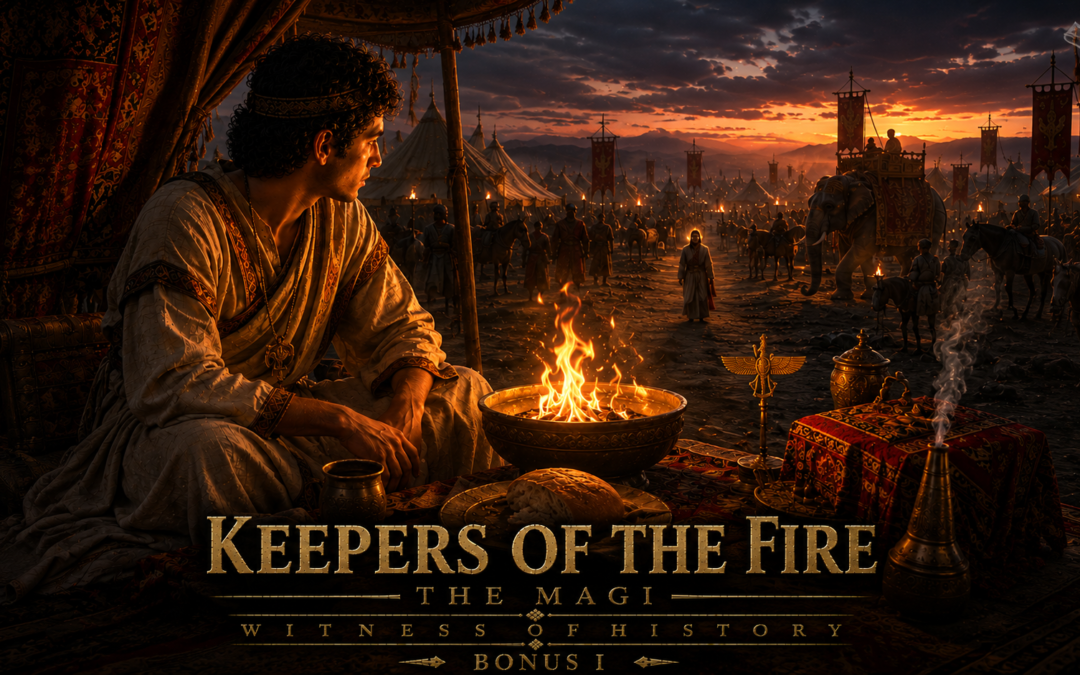
What was it like to stand between a king and the gods? Through the eyes of a young Persian Magus apprentice, spend a single anxious day in Darius III’s royal camp as his father is unexpectedly summoned before the Great King on the eve of Gaugamela while Alexander is waiting on the other side. Left behind to tend the sacred fire, the boy watches an empire prepare for battle while rumors spread of sacrifices, dreams, omens, and questions no one can answer with certainty.
This immersive historical podcast explores the Magi of the Achaemenid Empire, Persian religious traditions, Ahura Mazda, the sacred fire, the struggle between Truth and the Lie, and the immense responsibility carried by religious advisers serving the Great King. As fear for his father slowly becomes fear of one day taking his place, the apprentice discovers that the hardest part of serving kings is not knowing what the gods intend. It is knowing what to say when a king asks.
Narrator: A young Persian Magus apprentice
Setting: Persian royal camp before Gaugamela, 331 BCE
Historical Sources
Ancient Sources
- Herodotus, Histories
- Xenophon, Cyropaedia
- Strabo, Geography
- Arrian, Anabasis of Alexander (Book III)
- Quintus Curtius Rufus, History of Alexander
- Diodorus Siculus, Library of History
Modern Sources
- Pierre Briant, From Cyrus to Alexander: A History of the Persian Empire
- Mary Boyce, Zoroastrians: Their Religious Beliefs and Practices
- Albert de Jong, Traditions of the Magi
- Amélie Kuhrt, The Persian Empire
- Philip Freeman, Alexander the Great
- Adrian Goldsworthy, Philip and Alexander
- Robin Lane Fox, Alexander the Great
Author's Notes
Historical
- The Magi were members of the Persian priestly class who served important religious functions within the Achaemenid Empire, including conducting rituals, tending sacred fires, performing sacrifices, chanting hymns, and advising the royal court on religious matters.
- Ancient Greek authors consistently describe the Magi accompanying the Persian king during military campaigns. Pierre Briant also notes that before the royal procession marched, the sacred fire was carried before the army while the Magi walked nearby chanting ancestral hymns.
- Fire occupied a central place in Persian religious life as a symbol of purity and divine order. While the exact practices of portable sacred fires during campaigns are imperfectly known, the presence of the royal sacred fire with Darius' army is supported by the ancient sources.
- Persian religious thought emphasized Ahura Mazda, the Wise Lord, and the struggle between Truth (Asha/Arta) and the Lie (Drauga). This moral framework strongly influenced royal ideology during the Achaemenid period.
- Gaugamela brought together one of the most diverse armies assembled in antiquity. Persians, Medes, Armenians, Bactrians, Saka, Indians, and many other peoples served under Darius III before the decisive battle.
- Ancient sources do not record a specific dream of Darius III immediately before the Battle of Gaugamela. Dreams, sacrifices, celestial signs, and religious consultation were nevertheless well-established parts of royal life throughout the ancient Near East, making such possibilities entirely plausible within the historical setting.
Reconstructed
- The narrator, his father, their family, and their conversations are fictional.
- The messenger carrying the royal seal, the day's uncertainty, and the apprentice's waiting beside the sacred fire are literary reconstructions.
- The narrator's speculation that the summons might concern a sacrifice, an omen, a dream, or another matter intentionally reflects the uncertainty surrounding the royal court rather than asserting that any particular event occurred.
- The teachings about truth, the sacred fire, and the burden of interpreting signs are original dialogue inspired by Achaemenid religious beliefs and modern scholarship on the Magi rather than preserved historical quotations.
- The emotional transformation, from admiring the honor of serving the Great King to understanding the burden carried by the Magi, is fictional but intended to portray the human responsibility borne by those who stood between royal authority and religious interpretation.
This episode explores the world of the Persian Magi through the eyes of a young apprentice who slowly realizes that the greatest burden of his father's calling was never predicting the future, it was carrying the responsibility of advising kings when certainty was impossible.