
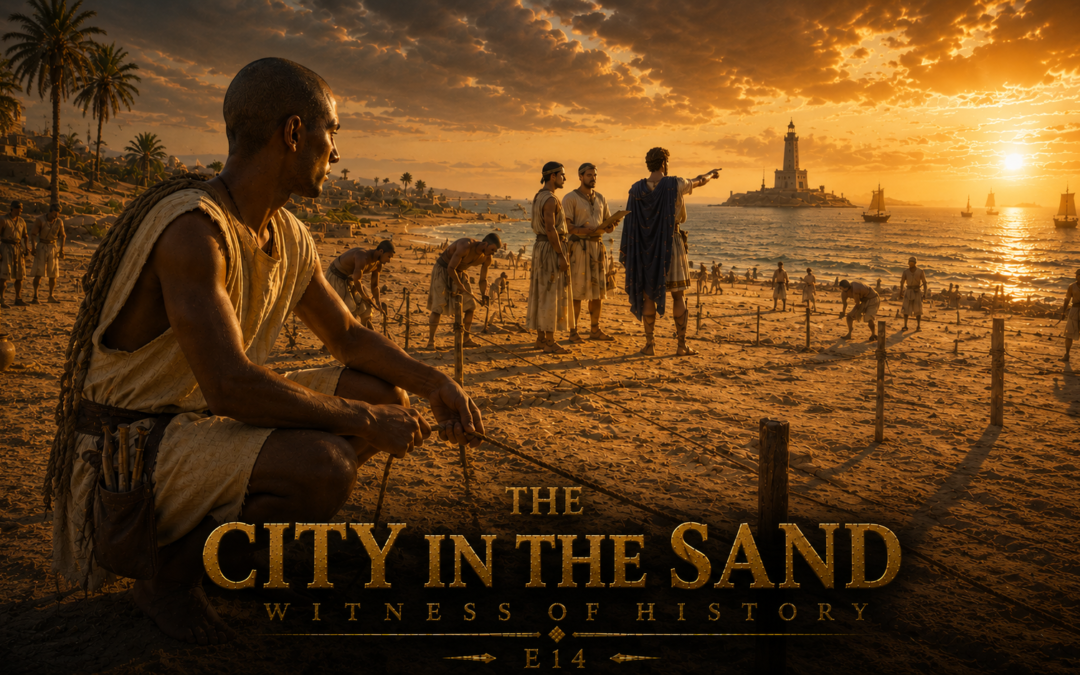
How do you build a city that has never existed? Through the eyes of Hori, a young Egyptian apprentice surveyor, witness Alexander's greatest act of creation as he lays out the foundations of Alexandria. This immersive historical podcast explores ancient engineering, Imhotep's enduring legacy, the founding of one of history's greatest cities, and the extraordinary vision that transformed an empty stretch of coastline into the crossroads of the ancient world.
Narrator: Hori, apprentice surveyor
Setting: Mediterranean coast of Egypt, 331 BCE
1. Historical Sources
a. Ancient Sources
- Arrian, Anabasis of Alexander
- Plutarch, Life of Alexander
- Diodorus Siculus, Library of History
- Strabo, Geography
b. Modern Sources
- Philip Freeman, Alexander the Great
- Peter Green, Alexander of Macedon
- Robin Lane Fox, Alexander the Great
- Adrian Goldsworthy, Philip and Alexander
2. Author’s Notes
a. Historical
- Alexander founded Alexandria in Egypt in 331 BCE on the Mediterranean coast west of the Nile Delta.
- The site was chosen near the island of Pharos, between the Mediterranean Sea and Lake Mareotis, giving the future city access to both sea trade and Egypt’s inland river system.
- Naucratis was the older Greek trading settlement in Egypt, located inland on the Nile system. It had served as a major point of contact between Egypt and the Greek world, but it was not suitable for Alexander’s larger Mediterranean vision.
- Ancient sources preserve the tradition that Alexander personally helped mark out the city’s plan.
- The story of using barley meal or flour to mark the city, followed by birds eating it, comes from the ancient foundation tradition.
- Aristander of Telmessus, Alexander’s trusted seer, interpreted the birds as a favorable omen, saying the city would feed or nourish many peoples.
- Alexandria later became one of the greatest cities of the ancient world: a major harbor, royal capital, center of learning, and meeting point between Greek, Egyptian, Near Eastern, and Mediterranean cultures.
- Imhotep, the architect associated with Djoser’s Step Pyramid at Saqqara, was remembered in later Egyptian tradition as a legendary sage, builder, healer, and figure associated with Ptah.
b. Reconstructed
- Hori, the narrator, is fictional.
- Hori’s father, the measuring rope, and the family conversations about Imhotep are fictional but based on Egyptian building traditions and the long cultural memory of Imhotep.
- The harbor pilot is fictional, but his role is historically plausible. Pilots and experienced sailors would have understood the Nile mouths, shoals, currents, winds, and practical difficulties of reaching inland ports like Naucratis.
- The conversations between Hori, Alexander, the harbor pilot, and Aristander are reconstructed.
- Hori’s emotional struggle, believing Egypt’s greatest works belonged to the past, then discovering that his generation could still build something lasting, is a dramatic reconstruction.
- The final image of Hori seeing Alexandria before it existed is poetic, not historical, but reflects the real transformation of an empty coastline into one of history’s most important cities.