
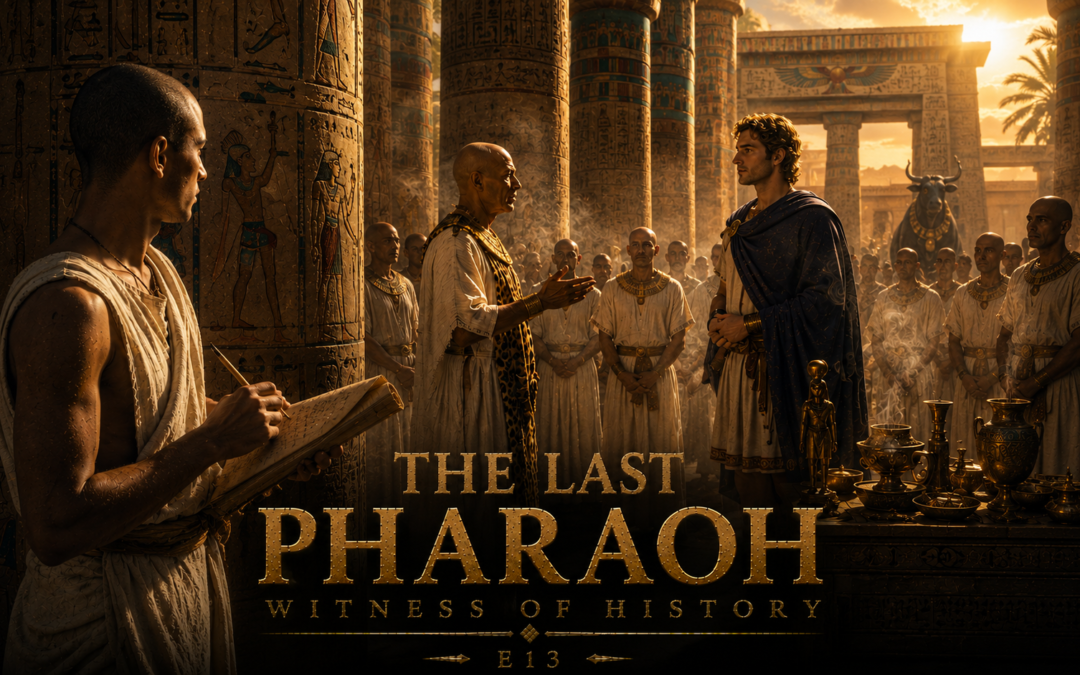
When Alexander the Great entered Egypt, he came not as a destroyer, but as a question. Through the eyes of Panehesy, a temple scribe of Ptah in Memphis, witness a land scarred by Persian rule, fearful for its gods, and uncertain whether to trust another foreign king. This immersive historical podcast explores Egyptian religion, Ma’at, the sacred Apis bull, and the moment Alexander was accepted as Pharaoh.
Narrator: Panehesy, Temple Scribe of the Great Temple of Ptah, Memphis
Setting: Memphis, Egypt — 332 BCE
1. Historical Sources
a. Ancient Sources
- Arrian, Anabasis of Alexander
- Plutarch, Life of Alexander
- Diodorus Siculus, Library of History
- Quintus Curtius Rufus, Histories of Alexander
- Herodotus, Histories
b. Modern Sources
- Peter Green, Alexander of Macedon
- Philip Freeman, Alexander the Great
- Robin Lane Fox, Alexander the Great
- Adrian Goldsworthy, Philip and Alexander
- Aidan Dodson, Afterglow of Empire: Egypt from the Fall of the New Kingdom to the Saite Renaissance
- Toby Wilkinson, The Rise and Fall of Ancient Egypt
2. Author's Notes
a. Historical
- Alexander entered Egypt in late 332 BCE after the fall of Gaza. The Persian satrap Mazaces surrendered Egypt without battle, allowing Alexander to occupy the country peacefully.
- Memphis was the administrative and religious capital of Lower Egypt, and the Great Temple of Ptah was among the most important religious centers in the country.
- Alexander publicly honored the Egyptian gods, made sacrifices according to local custom, and paid particular respect to the cult of the sacred Apis bull.
- Alexander spent several months in Egypt before departing for the Oracle of Siwa, during which he cultivated strong relationships with the Egyptian priesthood and organized Greek athletic and musical festivals in Memphis.
- Alexander was recognized as Egypt's legitimate ruler and represented as Pharaoh in Egyptian tradition. While no surviving ancient source preserves a detailed coronation ceremony, Egyptian inscriptions and later iconography clearly acknowledge his status as Pharaoh.
- The episode distinguishes between the legendary reputation of Cambyses II and the historically documented Persian reconquest under Artaxerxes III. Stories of Cambyses desecrating Egyptian religion are presented as Egyptian cultural memory rather than established historical fact, reflecting how many Egyptians of Alexander's time remembered Persian rule.
- The concepts of Ma'at, the divine responsibilities of Pharaoh, and the central role of the priesthood are based on well-established scholarship regarding ancient Egyptian religion and kingship.
b. Reconstructed
- Panehesy, his family, and all personal conversations are fictional.
- Panehesy's childhood visit to the Temple of Ptah, his father's lesson about the temple column, and the recurring symbolism of the column are literary devices created to illustrate the episode's central themes.
- The conversations between the priests concerning Alexander's suitability to become Pharaoh are fictional but are intended to reflect the broader religious and political questions facing the Egyptian priesthood.
- Panehesy's experience hiding temple records and witnessing the removal of sacred statues during the Persian reconquest is a reconstruction inspired by the insecurity experienced by Egyptian temples during periods of foreign invasion.
- The emotional journey from distrust to cautious hope is fictional, but is designed to represent the likely experience of many Egyptians who had lived under successive foreign rulers before Alexander's arrival.
- Alexander's dialogue is intentionally minimal. The episode emphasizes his actions rather than his words, allowing the transformation to be experienced through the eyes of an Egyptian witness rather than through Alexander himself.