
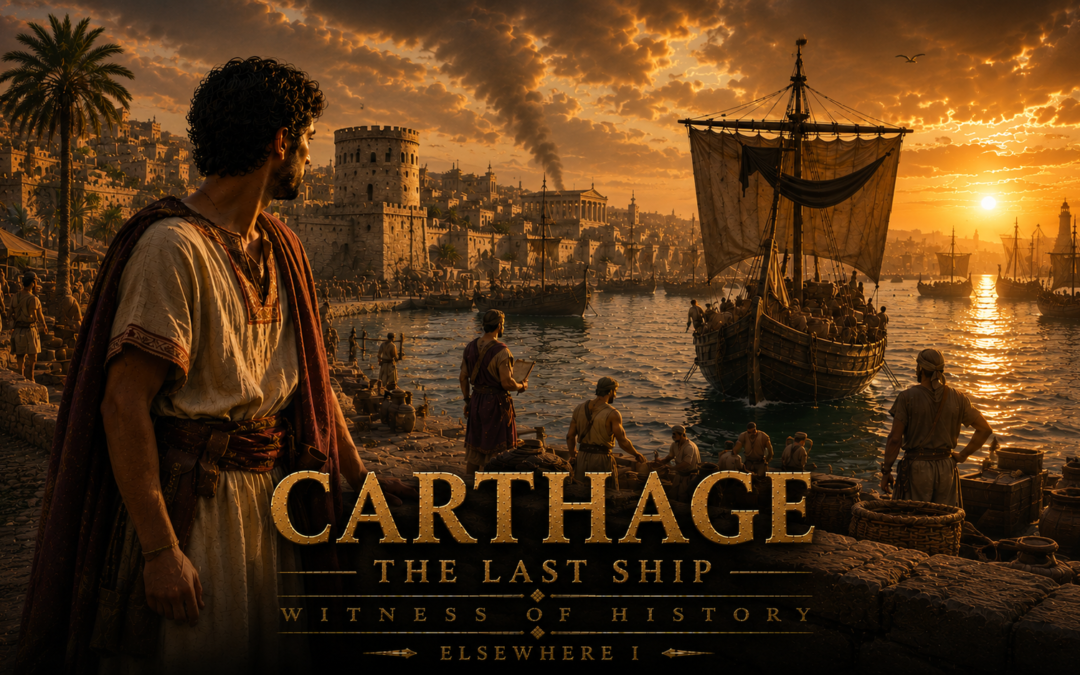
As Alexander the Great wages war against Tyre, the news travels slowly across the Mediterranean. Through the eyes of a young Carthaginian merchant, experience the siege from hundreds of miles away as rumors become refugees, and finally, the last ship from Tyre brings word that the ancient Phoenician mother city has fallen. This immersive historical podcast explores the enduring bond between Carthage and Tyre, revealing how the fall of one city echoed across an entire civilization.
Narrator: A young Carthaginian merchant
Setting: Carthage during the Siege of Tyre, 332 BCE
1. Historical Sources
- Richard Miles, Carthage Must Be Destroyed: The Rise and Fall of an Ancient Civilization
- Philip Freeman, Alexander the Great
- Robin Lane Fox, Alexander the Great
- Peter Green, Alexander of Macedon, 356–323 BC
2. Author's Notes
a. Historical
- Carthage was founded by settlers from Tyre, traditionally in the late ninth century BCE, and regarded Tyre as its mother city.
- By Alexander's time, Carthage had grown into the dominant Phoenician power in the western Mediterranean while maintaining cultural and religious ties to Tyre.
- Following the Battle of Issus, Alexander marched south to secure the Phoenician coast before advancing into Egypt.
- Tyre's refusal to admit Alexander led to the famous siege of 332 BCE.
- Throughout the siege, Tyre maintained maritime connections with the wider Mediterranean as long as its harbors remained accessible.
- As the siege progressed, news of events at Tyre spread gradually across the Mediterranean through merchant vessels and sailors.
- The arrival of the Phoenician and Cypriot fleets in Alexander's service isolated Tyre and greatly reduced its ability to communicate with or receive assistance from the outside world.
- After approximately seven months of resistance, Tyre fell to Alexander in 332 BCE.
- The fall of Tyre marked the end of the city's long dominance as the leading Phoenician metropolis, while Carthage continued to flourish as the greatest Phoenician power in the western Mediterranean.
b. Reconstructed
- The young Carthaginian merchant narrator.
- His family, profession, and daily life in the harbor of Carthage.
- The gradual arrival of rumors and news from Tyre.
- Conversations among merchants, sailors, and townspeople.
- The arrival of refugees from Tyre in Carthage.
- The dialogue with the sailor who had visited Tyre.
- The arrival of the final ship announcing Tyre's fall.
- The narrator's reflections on Carthage's relationship with its ancestral city.
- The metaphor comparing the loss of Tyre to losing "a grandmother I had never met."
- The emotional responses of ordinary Carthaginians to the distant fall of Tyre.