
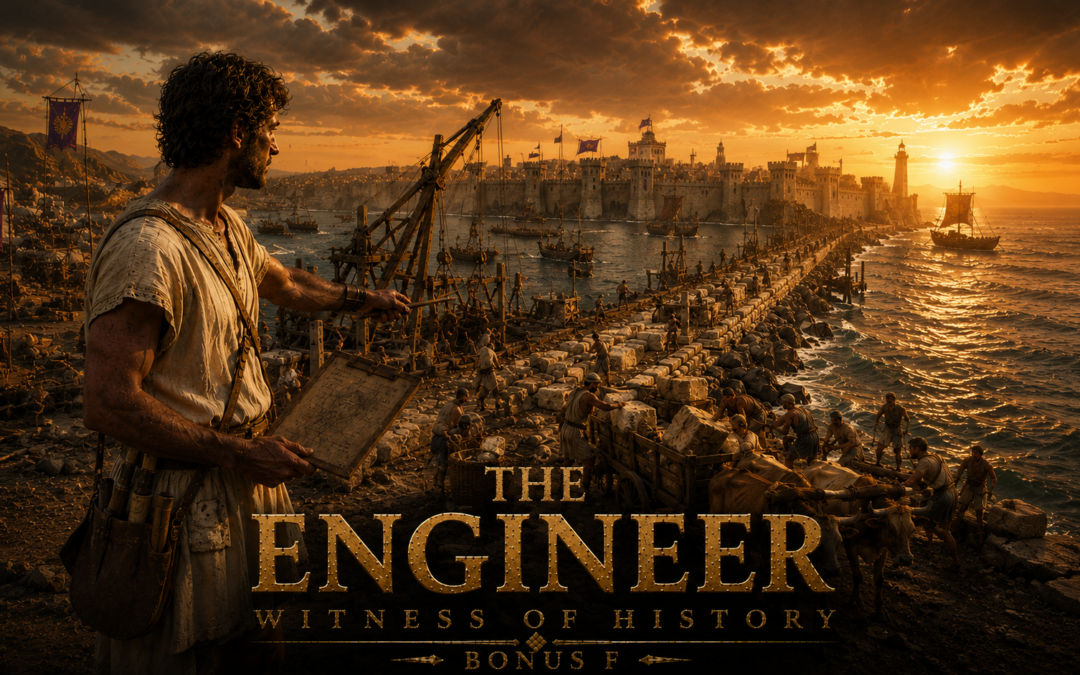
How did Alexander the Great conquer the seemingly unconquerable city of Tyre? Through the eyes of the engineer Diades of Pella, discover the remarkable ingenuity behind one of history's greatest sieges. This immersive historical podcast explores the engineering, persistence, and problem-solving that transformed an island fortress into a city within reach and forever changed the coastline of the ancient world.
Narrator: Diades of Pella, Macedonian military engineer
Setting: Siege of Tyre, 332 BCE
1. Historical Sources
a. Ancient Sources
- Arrian, Anabasis of Alexander
- Diodorus Siculus, Library of History
- Curtius Rufus, History of Alexander
- Plutarch, Life of Alexander
- Justin, Epitome of Pompeius Trogus
b. Modern Sources
- Adrian Goldsworthy, Philip and Alexander
- Philip Freeman, Alexander the Great
- Robin Lane Fox, Alexander the Great
- Peter Green, Alexander of Macedon, 356–323 BC
- Donald W. Engels, Alexander the Great and the Logistics of the Macedonian Army
- James Romm (ed.), The Landmark Arrian
2. Author's Notes
a. Historical
- During the Siege of Tyre in 332 BCE, Alexander faced the challenge of attacking an island city located roughly 800 meters (half a mile) offshore.
- Alexander ordered the construction of a massive stone-and-timber causeway linking the mainland to the island.
- The causeway was built largely from the ruins of Old Tyre, the abandoned mainland settlement opposite the island.
- Macedonian engineers had to contend with increasing water depth, strong currents, and rough seas as the causeway advanced.
- Storms repeatedly damaged sections of the causeway, forcing the Macedonians to rebuild and reinforce their work.
- As construction progressed into deeper water, the causeway was widened and strengthened to resist waves and enemy attacks.
- The Macedonians constructed enormous siege towers on the causeway, equipping them with artillery to support the assault.
- The Tyrians launched a successful fireship attack that destroyed several siege towers and damaged portions of the causeway.
- Alexander responded by rebuilding the siege works and adapting his engineering methods rather than abandoning the project.
- The arrival of allied Phoenician and Cypriot fleets eventually gave Alexander naval superiority and allowed Tyre to be blockaded from the sea.
- After approximately seven months, Alexander's forces breached Tyre's defenses and captured the city.
- The construction of the causeway permanently altered local coastal currents, gradually creating the peninsula that still connects ancient Tyre to the mainland today.
- Ancient sources mention Diades of Pella as one of Alexander's distinguished military engineers, although they provide few details about his role during the siege.
b. Reconstructed
- Diades of Pella as the first-person narrator.
- Alexander's conversations with Diades, including the question, "How deep?"
- The engineering team's discussions, measurements, calculations, and day-to-day problem solving.
- Diades' personal fascination with engineering and his obsessive determination to solve the challenge.
- The exchanges between Macedonian engineers and the Tyrian defenders.
- The engineer's emotional reactions to storms, structural failures, and the fireship attack.
- Alexander's question, "What have we learned?", following the storm damage.
- The narrator's reflections that engineering, rather than combat alone, made the conquest of Tyre possible.
- The return visit to Tyre years later and the narrator's observations of the altered coastline.
- The philosophical comparison between battles, kings, and the enduring legacy of engineering works.
This episode is designed as an "aha moment" episode. It reveals how one of the most famous sieges in history was won not only by soldiers, but by engineers and how their work can still be seen in the geography of Tyre today.