
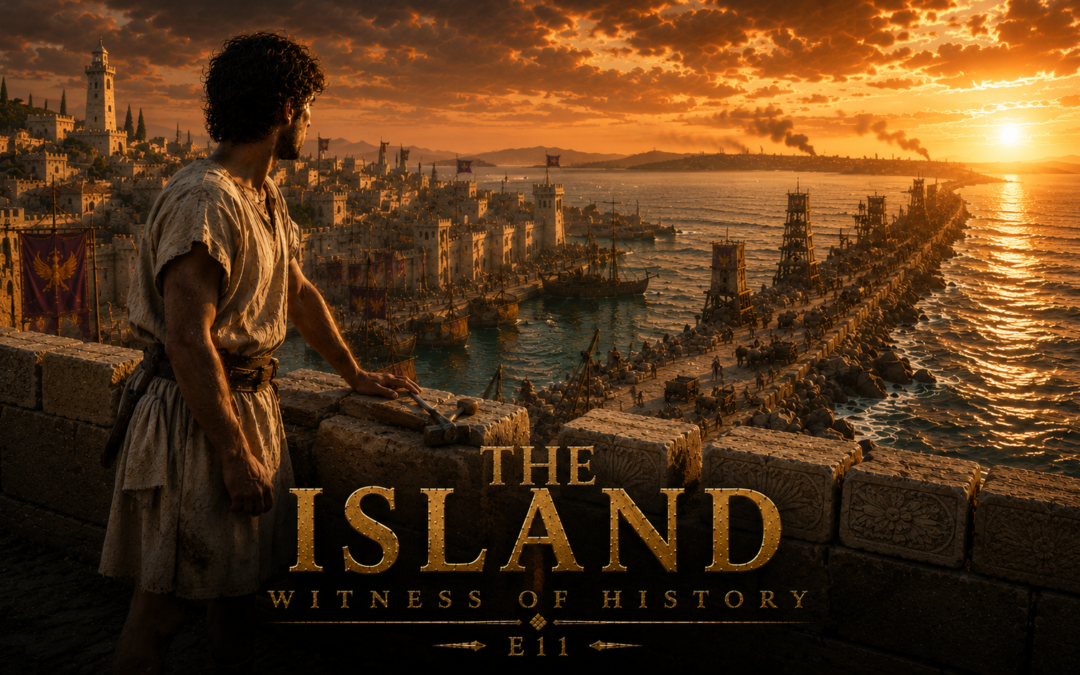
Alexander the Great has defeated the Persian king, but one city refuses to surrender. Through the eyes of a young Tyrian stoneworker, witness the Siege of Tyre from inside the walls of the ancient island fortress. As an impossible causeway slowly advances across the sea, confidence turns to dread in this immersive historical podcast exploring one of history's greatest sieges, the resilience of Tyre, and the relentless determination that made Alexander one of history's most formidable conquerors.
Narrator: Abdashtart, a young Tyrian stoneworker
Setting: Tyre, 332 BCE
1. Historical Sources
a. Ancient Sources
- Arrian, Anabasis of Alexander
- Diodorus Siculus, Library of History
- Curtius Rufus, History of Alexander
- Plutarch, Life of Alexander
- Justin, Epitome of Pompeius Trogus
b. Modern Sources
- Adrian Goldsworthy, Philip and Alexander
- Philip Freeman, Alexander the Great
- Robin Lane Fox, Alexander the Great
- Peter Green, Alexander of Macedon, 356–323 BC
- James Romm (ed.), The Landmark Arrian
2. Author's Notes
a. Historical
- In 332 BCE, following his victory at Issus, Alexander marched south along the Phoenician coast to secure the eastern Mediterranean before advancing deeper into the Persian Empire.
- Tyre was the most powerful Phoenician city and was located primarily on an island approximately 800 meters (half a mile) offshore.
- The city's island position and powerful fleet had made Tyre one of the best-defended cities in the ancient Mediterranean.
- Tyre's wealth came from maritime trade, its harbors, and the production of the famous Tyrian purple dye, prized throughout the ancient world.
- Alexander requested permission to enter Tyre and offer a sacrifice to Melqart, the city's chief god, whom the Greeks identified with Heracles.
- The Tyrians refused Alexander's request, seeking to preserve their neutrality while remaining loyal to the Persian king.
- Alexander responded by ordering the construction of a massive causeway from the mainland to the island.
- The causeway was built using stone, timber, and debris from the abandoned mainland settlement known as Old Tyre.
- Storms, waves, and deepening water repeatedly damaged sections of the causeway and slowed construction.
- As the causeway advanced into deeper water, Alexander adapted his methods and continued the project despite repeated setbacks.
- The persistence required to complete the causeway became one of the defining features of the siege.
- The construction of the causeway gradually convinced many defenders that Alexander intended to reach the island regardless of the time and cost involved.
- The siege ultimately lasted approximately seven months before Tyre was captured in 332 BCE.
b. Reconstructed
- Abdashtart, the young Tyrian stoneworker narrator.
- Elissa, the narrator's fiancée, their planned wedding, and their personal relationship.
- The narrator's family, including the argument with his father over whether Tyre should negotiate.
- Conversations between townspeople, sailors, merchants, and workers throughout the siege.
- The narrator witnessing the gradual construction of the causeway from the city walls and harbor.
- The emotional progression from confidence and mockery to growing fear as the causeway advanced.
- The repeated visits between Abdashtart and Elissa overlooking the Macedonian works.
- The specific dialogue surrounding Alexander's arrival and the city's reactions.
- The narrator's realization that Alexander's determination, rather than the causeway itself, posed the greatest threat to Tyre.
- The recurring phrase "The sea protects us" and its symbolic transformation throughout the episode.
- The episode concludes before the assault on Tyre, focusing on the psychological impact of watching the impossible slowly become inevitable rather than on the city's eventual fall.