
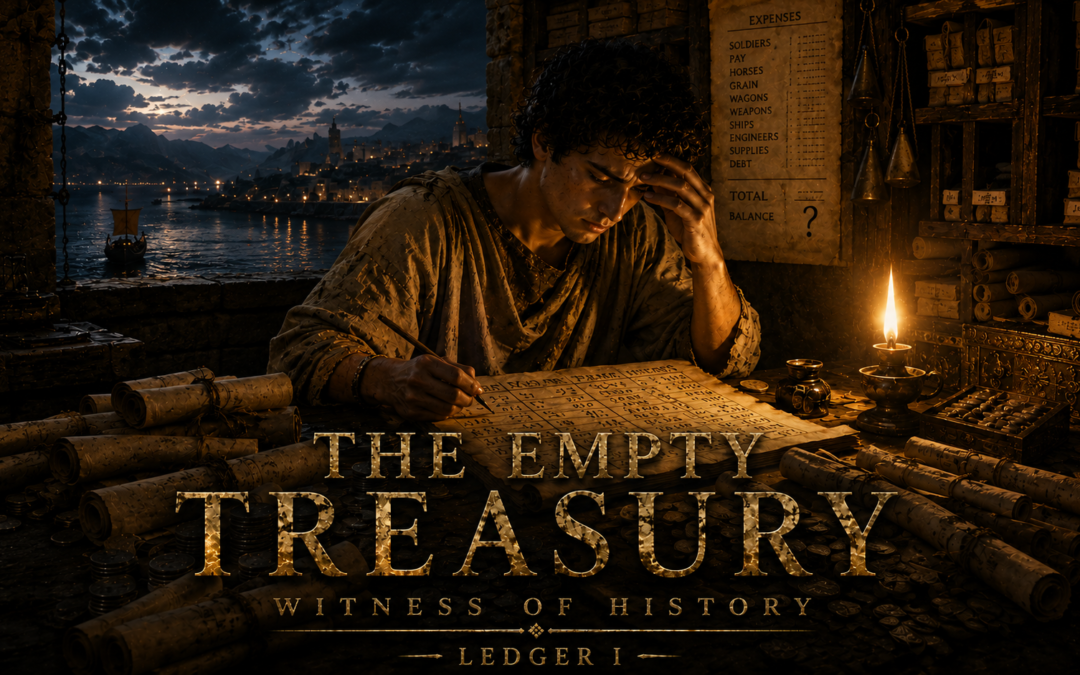
How did Alexander the Great finance his invasion of the Persian Empire? Through the eyes of a young treasury clerk, Menon, Understand the economics behind one of history's greatest campaigns, from Philip II's military reforms and mounting debts to the impossible gamble of crossing into Asia. A historical podcast revealing how silver, logistics, and risk can shape the fate of empires.
Narrator: Menon, Clerk of the Royal Treasury
Setting: Pella, 335–334 BCE
1. Historical Sources
a. Ancient Sources
- Arrian, Anabasis of Alexander
- Plutarch, Life of Alexander
- Diodorus Siculus, Library of History
- Quintus Curtius Rufus, History of Alexander
- Justin, Epitome of Pompeius Trogus
b. Modern Sources
- Adrian Goldsworthy, Philip and Alexander
- Peter Green, Alexander of Macedon, 356–323 BC
- Philip Freeman, Alexander the Great
- Robin Lane Fox, Alexander the Great
- N.G.L. Hammond, The Macedonian State
2. Author's Notes
a. Historical
- Philip II transformed Macedonia through military reform, territorial expansion, and revenues derived from mines, especially in the north.
- The Macedonian army became one of the most effective professional military forces in the Greek world.
- Maintaining that army required substantial and continuous financial resources.
- Ancient sources report that Alexander inherited a relatively small treasury and significant debts when he became king.
- Following Philip's assassination, Alexander faced revolts and instability across Greece.
- The revolt of Thebes in 335 BCE required a major military campaign and imposed additional financial burdens on the kingdom.
- After the fall of Thebes, many captives were sold into slavery.
- Alexander inherited Philip's plans for an invasion of the Persian Empire.
- The Persian Empire possessed immense financial resources accumulated over generations through taxation, tribute, trade, and royal treasuries.
- Persian gold darics and silver sigloi were among the most widely recognized and trusted currencies of the ancient world.
- Ancient historians repeatedly emphasize the enormous wealth later captured by Alexander in the Persian capitals.
b. Reconstructed
- Menon, the treasury clerk narrator.
- His promotion after Philip's assassination.
- His relationship with Harpalus.
- The detailed description of treasury operations.
- The preparation of a financial report for Alexander.
- The scene in which Alexander reviews the accounts.
- Alexander's question, "How long?"
- Conversations and interactions within the treasury.
- Menon's personal fears, calculations, and reflections.
- The specific argument that Macedonia invaded Persia because it could not afford not to.
c. Historical Debate
- Ancient sources disagree on the precise state of Macedonian finances when Alexander became king.
- Historians continue to debate the exact size of Alexander's inherited debts and available resources.
- Scholars also debate the extent to which economic necessity influenced the Persian campaign.
- While revenge for the Persian invasions, Philip's existing plans, personal ambition, and strategic considerations all played important roles, access to Persian wealth was undoubtedly one of the major potential rewards of the invasion.
This episode explores a side of history often hidden behind battles and kings: the financial reality of empire. While Menon is fictional, the concerns he voices reflect real questions faced by rulers, administrators, and historians alike. Armies march on courage, but they also march on silver.